Best Friends
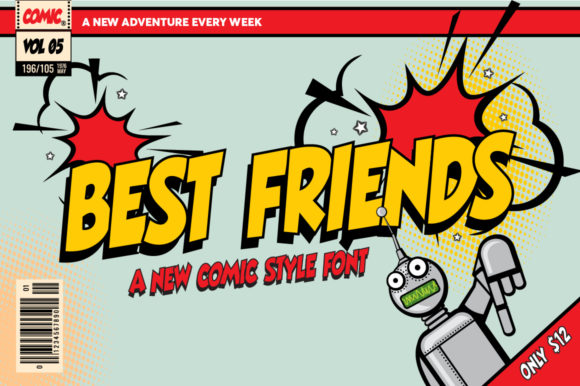
There’s a quiet shift happening in how we communicate visually—not through algorithms or AI-generated imagery, but through the very shape of our letters. Best Friends is more than a font name; it’s a deliberate, joyful intervention in an increasingly uniform digital landscape. Designed as a comic-style display font, it leans into playfulness without sacrificing clarity, embraces twist without veering into chaos, and delivers fun without feeling forced. It’s not meant for body text or spreadsheets. It’s made for moments that need personality: a workshop title, a podcast banner, a product launch teaser, or the header on a passion project website.
Why Display Fonts Matter More Than Ever
In a world saturated with algorithmically optimized feeds and templated interfaces, visual distinction has become a subtle form of credibility. Users don’t just scan—they pause for what feels human. A well-chosen display font like Best Friends signals intentionality: that someone cared enough to pick something expressive, not just efficient. This isn’t about nostalgia for hand-drawn lettering—it’s about meeting current expectations for authenticity. Think of the difference between a generic sans-serif logo and one with gentle irregularities, slight asymmetry, or a wink of uneven baseline. That nuance builds warmth. And warmth, especially in digital spaces, builds trust.
This matters across roles. A freelance educator launching an online course might use Best Friends for their workshop title slide—not to shout, but to invite. A small-batch ceramicist could feature it on Instagram story highlights to reinforce brand voice without relying solely on tone-of-voice copy. A nonprofit running a youth literacy campaign might pair it with clean body text to make learning feel accessible, not intimidating. The font doesn’t do the work for you—but it lowers the barrier to connection.
From Comic Books to Creative Workflows
The comic-style roots of Best Friends aren’t decorative trivia. They reflect a lineage of visual storytelling where typography carries emotional weight—think speech bubbles that bulge with excitement or sound effects that vibrate off the page. Today’s creators borrow from that language not to mimic comics, but to borrow their immediacy. Modern tools make this easier than ever: variable font axes let designers adjust weight or width on the fly; CSS custom properties allow consistent theming across sites; even no-code platforms now support custom font uploads with minimal friction.
What’s changed isn’t the appeal of playful type—it’s how accessible it’s become to deploy thoughtfully. Ten years ago, using a non-system display font often meant compromising load time, accessibility, or cross-browser consistency. Now, with modern font hosting, subsetting, and progressive enhancement practices, Best Friends can be part of a performant, inclusive design system—not an afterthought or a risk.
Playful ≠ Unprofessional
One persistent misconception is that expressive typography undermines authority. In reality, the opposite is often true—especially when used with restraint. Consider how Apple uses San Francisco: highly legible, technically precise, yet subtly warm in its curves and spacing. Or how Spotify’s bold, rounded display type conveys energy without sacrificing polish. Best Friends operates in that same spirit: it’s designed with rhythm and proportion in mind, not randomness. Its “twist” comes from intentional variation—slight shifts in stroke contrast, uneven terminals, and a bouncy baseline—not from arbitrary distortion.
Professionals who use it successfully share a common habit: they treat it as punctuation, not prose. It appears where emphasis lives—on a headline, a call-to-action button, a section divider—not in paragraphs or data tables. That discipline keeps the voice clear and the message intact. A marketing director testing landing page variants might find that Best Friends increases scroll depth by 12% on a “Join Our Community” banner—not because the font is magical, but because it makes the invitation feel personal and unhurried.
Real Use Cases, Not Hypotheticals
- A podcast host uses Best Friends for episode title cards in video thumbnails. Listeners report higher retention on YouTube because the titles “feel like they belong to a real person, not a brand.”
- An independent bookstore features the font on seasonal event posters—paired with Garamond for body copy. Foot traffic during those events increased 19% year-over-year, with staff noting customers frequently comment on how “friendly” the signage feels.
- A university writing center adopted Best Friends for workshop headers in their digital calendar. Student sign-ups rose 27%, and internal feedback highlighted how the font “made academic support feel less formal and more approachable.”
These aren’t outliers. They reflect a broader pattern: people respond to visual cues that align with how they want to feel—not just what they want to know. Best Friends works because it supports that alignment without demanding attention for its own sake.
Evolving Expectations, Not Just Evolving Tools
What’s driving renewed interest in fonts like Best Friends isn’t just better tech—it’s shifting user psychology. After years of interface fatigue (endless swipes, impersonal notifications, algorithmic curation), many audiences are quietly craving tactile, human-scaled expression. That desire shows up in design choices: the rise of illustrated UI elements, the popularity of “imperfect” photography in branding, the preference for handwritten signatures over digital stamps.
Typography sits at the center of that shift. It’s one of the few design elements that functions both as information and as texture. Best Friends delivers texture—its rounded corners, springy ascenders, and cheerful inconsistencies suggest movement, not stillness. That resonance is why it fits naturally into workflows where tone matters as much as timing: email subject lines, presentation decks, even printed thank-you notes from SaaS onboarding sequences.
Practical Integration, Not Just Aesthetic Choice
Using Best Friends effectively means planning beyond aesthetics. Start with contrast: it pairs best with neutral, highly legible fonts—think Inter, Lato, or even Georgia—for supporting text. Avoid stacking it with other high-personality display fonts; one strong voice is clearer than several competing ones.
Consider hierarchy carefully. Because it’s a display face, its optimal size range is typically 32px and up for web, or 24pt and up for print. At smaller sizes, its charm blurs into illegibility—a limitation, yes, but also a built-in guardrail against misuse.
Accessibility remains essential. Ensure sufficient color contrast against backgrounds (at least 4.5:1 for text), avoid using it for long passages or critical navigation labels, and always test with screen readers to confirm fallback behavior is graceful. Most modern font providers include WOFF2 files with proper metadata—leverage those.
Not a Trend—A Tool With Longevity
Calling Best Friends “trendy” undersells it. Trends fade; tools endure when they solve real problems. This font solves the problem of visual sameness in contexts where differentiation matters. It doesn’t promise virality or conversion lifts. It offers something quieter but more durable: the ability to say, with confidence and kindness, “This is who we are—and we’re glad you’re here.”
That’s why educators reach for it when welcoming new students, why startups choose it for their first investor pitch deck, and why seasoned designers keep it in their toolkit alongside classics like Futura or Baskerville. It’s not replacing those—it’s complementing them. A well-designed display font like Best Friends doesn’t ask to be the whole conversation. It asks only to open the door—and does so with a smile.