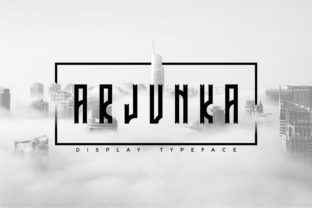
Arjunka: Where Urban Edge Meets Modern Typography
Typography isn’t just about legibility—it’s about attitude. It’s the first impression your design makes before a single word is read. And when your project demands something that feels raw, real, and unmistakably city-born, Arjunka doesn’t just fit in—it steps forward with swagger.
A Font That Doesn’t Ask Permission
Arjunka isn’t polished to perfection. It’s deliberately unrefined—sharp angles, uneven baselines, subtle texture in its strokes, and a rhythm that leans slightly off-grid. That’s not a flaw; it’s intention. This font carries the energy of street art, indie zines, and late-night neon-lit alleyways. Its urban character isn’t simulated—it’s baked into every glyph.
Unlike many “grunge” fonts that rely on heavy distressing or forced decay, Arjunka balances edge with elegance. The uppercase letters have confident weight and presence, while lowercase forms introduce controlled irregularity—slight tapering, asymmetrical curves, and intentional inconsistencies that feel hand-drawn but digitally precise. It’s the kind of typeface that works equally well on a limited-edition vinyl sleeve or a high-end boutique storefront sign.
Why Designers Reach for Arjunka First
When you’re choosing a font, you’re not just picking shapes—you’re selecting tone, audience, and context. Arjunka answers specific creative needs:
- Brands building authenticity: Startups, independent fashion labels, music collectives, and local cafés use Arjunka to signal they’re grounded—not corporate, not generic, but intentionally human.
- Design systems needing contrast: Pair Arjunka with clean sans-serifs like Inter or Poppins for headlines or logos, then drop into neutral body text. The juxtaposition creates visual hierarchy without shouting.
- Digital interfaces with personality: Used sparingly—on hero banners, CTA buttons, or app splash screens—Arjunka injects identity into otherwise functional spaces.
- Print projects craving tactile resonance: Letterpress posters, risograph flyers, and screen-printed merch gain instant texture and depth thanks to Arjunka’s built-in rhythm and weight variation.
It’s not meant for long-form reading—but that’s by design. Arjunka thrives where impact matters more than endurance: packaging, social media banners, event posters, album art, and even animated UI elements.
Fitting Arjunka Into Real Workflows
Adopting a distinctive font like Arjunka means thinking beyond aesthetics—it’s about integration. Here’s how it lands in practice:
For freelance designers: Clients often come with vague briefs like “make it cool” or “feel young and bold.” Arjunka becomes a strategic shortcut—not because it’s trendy, but because it communicates confidence and clarity fast. Present it alongside two restrained supporting fonts, and suddenly your mood board has direction. Bonus: its OpenType features (including stylistic alternates and ligatures) let you fine-tune expression without switching families.
In branding studios: Arjunka shines during identity development when a client wants to differentiate from competitors using overused display fonts. It avoids the trap of looking like every other “urban” brand—it has enough nuance to scale across applications. A coffee roaster might use Arjunka for their bag seal and menu headers, then switch to a warm serif for origin stories. The font doesn’t dominate the voice—it sharpens it.
Within marketing teams: Social creatives love Arjunka for Instagram carousels and TikTok thumbnails. Its strong letterforms hold up at small sizes on mobile, and its distinct spacing ensures readability even over busy backgrounds. Just avoid cramming too much text—let it breathe. One powerful headline in Arjunka beats three lines of cluttered copy.
What to Watch For (Practical Considerations)
Like any expressive typeface, Arjunka rewards thoughtful use—and punishes careless application. Keep these points in mind:
- Licensing clarity: Check usage rights before deploying Arjunka in apps, SaaS dashboards, or embedded digital signage. Some licenses cover web use but exclude variable font embedding or extended redistribution—always verify.
- Pairing discipline: Arjunka stands out because it contrasts. Don’t pair it with other high-contrast or decorative fonts. Stick to neutral, highly legible companions—think Roboto, Lato, or even Georgia for print-heavy layouts.
- Weight awareness: Arjunka’s default weight carries significant visual gravity. Use lighter weights (if available in your version) for secondary text, or adjust tracking and line height to prevent crowding.
- Accessibility balance: While Arjunka passes basic WCAG contrast checks at larger sizes, avoid using it for UI labels, form fields, or body copy under 24px. Its stylistic quirks reduce scannability for some readers—so reserve it for moments where tone trumps utility.
Also worth noting: Arjunka renders exceptionally well across modern browsers and devices. Its hinting and spacing are optimized for both Retina displays and standard-resolution screens—no fuzzy edges, no inconsistent kerning. That reliability makes it safer for time-sensitive campaigns where QA windows are tight.
Arjunka Beyond the Obvious
There’s a quiet versatility hiding beneath Arjunka’s bold surface. It’s been used effectively in unexpected contexts—like nonprofit campaign materials targeting Gen Z audiences, where its authenticity helps bypass skepticism. Or in editorial design for culture magazines, where its irregular rhythm echoes the non-linear storytelling common in long-form digital features.
Some designers even use Arjunka as a “visual anchor” in presentations—applying it only to slide titles or section dividers. It subtly reinforces brand continuity without overwhelming content. Others leverage its stylistic alternates to create custom monograms or initials for personal branding packages.
And yes—it works in motion. When animated with slight staggered reveals or subtle scaling, Arjunka’s angular confidence translates beautifully to video intros and interactive web experiences. Its structure holds up under transformation, unlike overly delicate or ornate alternatives.
Getting Started With Intention
If you’re new to Arjunka, start small. Try it on a one-page project: a gig poster, a product launch banner, or a newsletter header. Pay attention to how it changes the emotional temperature of your layout. Does it feel urgent? Confident? Rebellious? Playful?
Then ask: does that match what your audience needs to feel? If you’re launching a sustainable sneaker line, Arjunka might reinforce craftsmanship and grit. If you’re designing for a meditation app? Probably not the right fit. Context is everything.
Download a trial version first. Test it across devices. Print a sample. See how it behaves with your brand colors—especially dark backgrounds or metallic foils. Arjunka’s texture interacts differently depending on substrate and ink density.
Finally, remember: typography is never neutral. Every font choice signals something. With Arjunka, you’re choosing honesty over polish, character over conformity, and urban vitality over sterile minimalism. It won’t suit every project—but when it does, it transforms good design into unforgettable design.