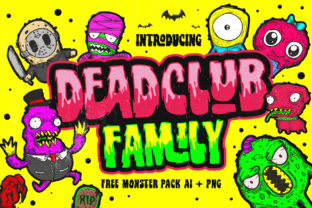
Deadclub Family: Where Playful Energy Meets Dark Aesthetic
Deadclub Family isn’t just another display font—it’s a deliberate stylistic pivot for creators who refuse to choose between personality and precision. Designed with expressive contrast, exaggerated terminals, and subtle grotesque undertones, this font family balances macabre charm with clean legibility at larger sizes. Its dual nature—fun yet unsettling, retro yet contemporary—makes it especially resonant in today’s visual landscape, where authenticity and tonal nuance matter more than ever.
Why Deadclub Family Fits the Moment
Consumers and audiences aren’t responding to generic polish anymore. They’re drawn to work that signals intention—not just “this looks nice,” but “this knows exactly what it is.” That shift has elevated display fonts from decorative afterthoughts to strategic communication tools. Deadclub Family arrives at a time when brands, indie publishers, and digital creators are rethinking tone: a podcast about urban legends doesn’t need gothic blackletter—it needs something with attitude, rhythm, and a wink. A boutique apparel line launching a limited “Midnight Carnival” collection benefits from typography that hints at nostalgia, mischief, and controlled chaos—all qualities baked into Deadclub Family’s letterforms.
This aligns with broader shifts in creative workflows. Designers increasingly layer type as narrative devices—not just hierarchy aids. Deadclub Family supports that practice: its uppercase variants deliver punch for headlines or logos, while the lowercase forms retain enough structure to function in short subheads or capsule captions without collapsing into illegibility. It’s not meant for body text, and it doesn’t pretend to be. Its purpose is focused, intentional, and context-aware.
From Niche to Necessary: How Display Typography Evolved
Fifteen years ago, display fonts were often relegated to Halloween flyers or metal band merch—functional within narrow constraints. Today, they’re embedded in UI microcopy (think animated splash screens), social media banners, editorial feature graphics, and even physical product packaging where shelf presence hinges on instant recognition. The rise of no-code platforms and template-driven design has also increased demand for fonts that “work out of the box”—fonts with built-in character that don’t require heavy customization to feel distinctive.
Deadclub Family reflects that evolution. Its spacing is optimized for screen readability at common banner sizes (e.g., 48–96px), and its OpenType features—including stylistic alternates and ligatures—offer subtle variation without demanding advanced typographic knowledge. You don’t need to be a font engineer to get value from it. A marketer building a Canva presentation can select the bold weight and instantly convey urgency and flair; an educator designing a themed lesson slide on folklore can use the lighter cut to suggest playfulness without sacrificing clarity.
Real-World Use Cases That Go Beyond Gimmick
- Podcast branding: A true-crime series titled “Static & Bones” uses Deadclub Family for its logo and episode thumbnails—leveraging the font’s uneven baseline and sharp serifs to evoke analog distortion and vintage radio aesthetics, while remaining scannable on mobile feeds.
- Independent publishing: A small press releasing illustrated chapbooks of surreal short fiction pairs Deadclub Family headlines with a neutral sans-serif body font. The contrast creates breathing room and signals genre without resorting to cliché horror tropes.
- Event promotion: A local art collective hosting an immersive “Neo-Nocturne” exhibition uses Deadclub Family across printed posters and Instagram Stories. Its rhythmic irregularity mirrors the event’s blend of analog projection and digital interactivity—making typography part of the experience, not just its label.
Practical Considerations for Professionals
Using Deadclub Family effectively isn’t about applying it everywhere—it’s about knowing where its strengths land and where it steps back. Because it’s a display family, it performs best above 36px in digital contexts and 18pt+ in print. Pairing matters: avoid competing decorative fonts. Instead, anchor it with a highly legible, low-contrast sans-serif (like Inter, Poppins, or even Helvetica Now) for supporting text. That contrast does double duty—it improves accessibility and reinforces hierarchy.
Color usage also plays a role. Deadclub Family’s high stroke contrast responds well to flat, saturated palettes—deep burgundy, electric lime, matte black—but can lose impact against busy backgrounds or low-contrast gradients. Test at actual size and context: a headline that reads clearly on a desktop monitor may blur or jitter on older mobile displays if rendered too thin or at low resolution.
For developers embedding it via web font services, note that Deadclub Family includes variable axis support in select weights. This means you can fine-tune weight or width responsively—scaling visual density based on viewport size rather than switching entirely between static files. That’s not just convenient; it reduces HTTP requests and improves Core Web Vitals, especially important for creators managing their own sites or portfolios.
Not Just for “Horror” — A Broader Creative Utility
While its roots nod to campy B-movie posters and underground zine culture, Deadclub Family’s utility extends far beyond literal genre applications. Its energy translates well to projects centered on transformation, rebellion, irony, or theatricality—think campaign visuals for a sustainability initiative using “decay-to-renewal” metaphors, or branding for a synthwave music festival that leans into analog warmth rather than digital coldness.
What makes it adaptable is restraint. Unlike some display fonts that rely on extreme distortion or excessive ornamentation, Deadclub Family keeps its eccentricities grounded in proportion and rhythm. The “fun” comes from subtle quirks—the slight tilt on the capital A, the extended tail on the Q—not from randomness. That discipline gives it staying power. A brand won’t outgrow it in six months because it’s not riding a single trend; it’s tapping into a longer-standing appetite for human-inflected design in an increasingly automated world.
Getting Started Without Overcommitting
If you’re evaluating Deadclub Family for a project, start small. Try it in one high-impact location: a hero section headline, a logo lockup, or a featured quote block. Compare how it changes perception—not just aesthetics, but emotional resonance. Does it make your message feel bolder? More memorable? Slightly unpredictable in a way that feels intentional?
Also consider licensing scope. Deadclub Family offers tiered options covering personal use, commercial websites, app interfaces, and physical merchandise. For freelancers or small studios juggling multiple clients, the extended license often proves cost-effective—especially since consistent typography strengthens brand continuity across touchpoints.
Finally, trust your eye over algorithmic “trend reports.” Deadclub Family won’t dominate every design system, and it shouldn’t. But when your goal is to signal confidence, curiosity, or controlled edge—without shouting or leaning on tired references—it offers a rare combination: personality with precision, flair with function.