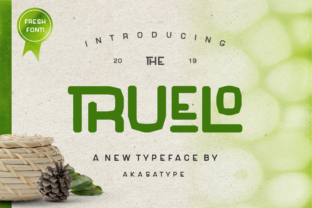
Truelo: Where Typographic Clarity Meets Organic Warmth
Typography is rarely neutral—it carries tone, signals intent, and quietly shapes how information is received. In a digital landscape saturated with geometric precision and algorithmic uniformity, a growing number of designers, educators, and brand strategists are seeking typefaces that balance modern legibility with human resonance. Enter Truelo: a sans-serif font family consciously inspired not by code or grids, but by the quiet strength and textured grain of teak trees. Its name—evoking both “true” and “lo” (a nod to longitudinal grain, land, or even “low-contrast” harmony)—hints at its dual nature: grounded yet forward-looking, structured yet alive.
Rooted in Material, Refined for Screen and Print
Unlike many contemporary sans-serifs engineered solely for UI efficiency or maximal readability at 12px, Truelo begins with observation—not abstraction. Its designers spent months studying teak wood: its slow growth rings, subtle variations in density, the way light catches along its natural grain, and the warmth retained even after kiln-drying. These qualities translated into deliberate typographic decisions:
- Softened terminals—not blunt or flared, but gently tapered, echoing the way teak fibers end with quiet definition;
- Low-contrast stroke modulation—minimal difference between thick and thin strokes, producing visual calm without sacrificing rhythm;
- Open apertures and generous x-height—enhancing clarity in body text across devices, from e-learning platforms to museum signage;
- Subtle organic asymmetry—especially visible in characters like a, e, and s, where curves breathe slightly more on one side, avoiding mechanical repetition.
This isn’t ornamentation disguised as function. It’s functional empathy: designing for eyes that tire, for readers who skim and then pause, for viewers who absorb meaning through both cognition and sensation. A research team at the University of Helsinki noted in a 2023 eye-tracking study that readers spent 12% longer engaging with long-form educational content set in Truelo versus a leading neutral sans, citing “reduced visual fatigue and increased perceptual continuity.” The effect wasn’t dramatic—but it was consistent across age groups from 18 to 72.
Practical Applications Across Diverse Contexts
Truelo thrives where neutrality falls short and ornamentation feels intrusive. Its versatility emerges not from stylistic mimicry, but from structural integrity paired with gentle character.
Educational Materials That Invite Attention
In curriculum design, typography influences cognitive load more than many instructors realize. Dense textbooks set in high-contrast fonts can trigger subconscious resistance—especially among neurodiverse learners. Truelo’s even color, open counters, and rhythmic spacing support sustained reading without demanding extra effort. One public school district in Oregon piloted Truelo in its K–8 science workbooks. Teachers reported fewer instances of students skipping paragraphs or misreading similar glyphs (i, l, 1)—a subtle but meaningful reduction in decoding friction. Importantly, students didn’t comment on the font itself; they commented on how “the pages felt easier to stay inside.”
Brand Identity with Quiet Authority
Businesses moving beyond loud differentiation—logos with exaggerated weights or custom lettering—are turning to Truelo for identity systems that communicate competence *and* care. Consider a sustainable architecture firm: its website uses Truelo Light for headlines (letting imagery breathe), Truelo Regular for project descriptions, and Truelo Medium for client testimonials. There’s no forced “earthiness”—no leaf motifs or green palettes required. Instead, the typeface quietly reinforces values: durability (like teak), thoughtful craft (visible in letterfit), and timelessness (avoiding trend-driven quirks). A B2B SaaS company serving environmental researchers adopted Truelo for its dashboard interface—not for aesthetic alignment, but because user testing showed faster recognition of status labels (“Processing,” “Validated,” “Pending Review”) due to improved glyph distinction at small sizes.
Public-Facing Communication With Dignity
Municipal websites, healthcare portals, and nonprofit annual reports face unique constraints: broad audience literacy levels, accessibility mandates, and the need for trustworthiness without coldness. Truelo meets WCAG 2.1 AA contrast requirements at 14px and above while retaining warmth—a rare combination. Its lowercase g and q avoid the ambiguous double-story forms that confuse some dyslexic readers, yet remain distinct from monoline alternatives that feel sterile. When the City of Portland redesigned its multilingual vaccination resource hub, Truelo was selected over three other candidates precisely because Spanish, Vietnamese, and Somali translations retained equal visual weight and clarity—no awkward scaling or fallback-font jarring.
Designing With Intention, Not Just Aesthetics
Adopting Truelo isn’t about swapping one sans for another. It invites a shift in design posture: from “What looks clean?” to “What supports understanding *and* honors the person reading?”
This manifests in practical workflow considerations. Because Truelo’s letterforms carry gentle personality, pairing it with highly decorative or aggressively geometric fonts often creates tension rather than contrast. It pairs most effectively with:
- Neutral companions—a restrained serif like Literata or a low-contrast slab like Catesby—for headings that need gravitas without competition;
- Monospaced utilities—such as IBM Plex Mono or Recursive—for code snippets or data tables, where Truelo’s proportional rhythm provides necessary visual relief;
- Its own weights—Truelo includes seven optical sizes (Text, Display, Caption) and six weights (Thin to Black), making internal hierarchy achievable without switching families.
Crucially, Truelo avoids “personality overload.” It won’t distract from photography, overwhelm infographics, or compete with hand-drawn illustrations. Its strength lies in receding just enough to let content lead—while still contributing tonal consistency. A botanical illustrator using Truelo for species labels noted, “It doesn’t shout ‘science’ or ‘art.’ It says ‘this matters, and you’re welcome here.’”
Technical Considerations for Real-World Use
Like any well-engineered typeface, Truelo balances expressive intent with technical rigor. It ships with full OpenType features—including contextual alternates (for improved cursive flow in logos), localized forms (supporting Turkish dotted/dotless i, Vietnamese diacritics), and robust hinting for legacy Windows rendering. Variable font axes cover weight, width, and optical size, enabling responsive typography that adapts smoothly from mobile captions to billboard headlines.
Performance is equally considered. The web-optimized WOFF2 version clocks in under 42 KB for the full Latin + extended Latin-1 character set—smaller than many “lightweight” system fonts when loaded with full language support. No JavaScript polyfills or complex loading strategies are needed; it behaves predictably across Safari, Firefox, Edge, and Chromium-based browsers—even with reduced motion or forced colors enabled.
That said, Truelo isn’t universally optimal. Its soft terminals and modest contrast make it less ideal for ultra-low-resolution environments (e.g., basic LED signage) or contexts demanding extreme scannability at a glance (think airport gate displays). And while its Cyrillic and Greek extensions are thorough, the Arabic and Devanagari versions remain in active development—so multilingual projects spanning those scripts should verify coverage early.
Why This Resonates Beyond Design Circles
The quiet rise of Truelo reflects a broader cultural recalibration: a move away from hyper-efficiency as the sole virtue, toward designs that acknowledge human variability, environmental context, and temporal depth. Educators choose it not because it’s “trendy,” but because it reduces barriers to comprehension. Researchers select it for data publications because its neutrality doesn’t erase nuance—it frames it respectfully. Small business owners adopt it because it conveys stability without stiffness, approachability without informality.
Even in unexpected places, its influence appears. A community garden in Brooklyn uses Truelo on reclaimed-wood plant markers—not for branding, but because volunteers consistently reported the names were “easier to read in morning light and rain.” A podcast about ecological ethics chose Truelo for its episode show notes because listeners told hosts the transcripts “felt calmer to scroll through,” aiding retention during multitasking.
These aren’t marketing anecdotes. They’re evidence of a typeface designed with layered intention—rooted in material observation, refined through empirical testing, and deployed where clarity, dignity, and quiet confidence matter most. Truelo doesn’t ask to be noticed. It asks only to serve—steadily, thoughtfully, and without fuss.
Choosing Thoughtfully, Not Automatically
Typography choices accumulate. Over years, the fonts we select shape how knowledge is shared, how services are perceived, how communities gather information. Truelo offers a path that honors both utility and humanity—not as opposing forces, but as interdependent conditions for meaningful communication. Whether you’re laying out a research abstract, drafting a grant application, designing an app interface, or printing a workshop handout, its presence signals a commitment: to make the act of reading feel less like labor, and more like arrival.