Fancyrib: A Funny, Stylish Font That Adds Authenticity to Your Design Projects
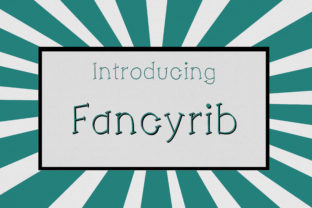
When you're crafting a logo, designing social media graphics, or building a brand identity, typography does more than convey words—it sets the tone, signals personality, and builds emotional resonance. That’s where Fancyrib stands out: it’s not just another decorative font. It’s a funny, stylish font with expressive curves, playful irregularities, and a hand-crafted charm that instantly communicates warmth, wit, and authenticity. For designers, marketers, and small business owners who want their visuals to feel human—not robotic—Fancyrib is a quietly powerful tool.
Many professionals face a common challenge: balancing professionalism with personality. Corporate fonts often feel stiff or generic; overly quirky typefaces can undermine credibility. You need something that feels intentional—not gimmicky—that works across contexts without sacrificing legibility or brand coherence. That’s the gap Fancyrib fills. Its slightly uneven baseline, subtle ink-bloom effect, and confident yet relaxed letterforms give it the look of expertly drawn lettering—like a skilled designer sketched it live—not an algorithm-generated novelty.
Consider a local café launching a new seasonal menu. They want signage and Instagram posts that feel inviting, locally rooted, and memorable—but not childish or dated. A standard sans-serif might read as sterile; a heavy script font could feel outdated or hard to scan. Fancyrib, used for headings and feature names (e.g., “Honey Lavender Latte” or “Saturday Brunch Special”), adds instant character while remaining highly readable at medium sizes. It signals approachability without sacrificing polish—a rare balance many fonts miss.
Similarly, independent creators launching digital products—think print-on-demand apparel, indie zines, or podcast merch—often struggle to stand out in saturated markets. Their audience responds to sincerity and stylistic confidence. Here, Fancyrib becomes more than typography: it’s part of the brand voice. Used sparingly on a t-shirt chest print or podcast cover art, it conveys humor and self-awareness—qualities that build connection far faster than polished perfection ever could.
Practical application starts with smart usage—not overuse. Fancyrib shines as a display font: ideal for headlines, logos, posters, social banners, packaging accents, and short callouts. Avoid body text or dense paragraphs; its stylistic details reduce readability at small sizes and low resolutions. Instead, pair it thoughtfully—for example, with a clean, neutral sans-serif like Inter, Lato, or Open Sans for supporting text. This contrast reinforces hierarchy, improves scannability, and lets Fancyrib do what it does best: grab attention and set the mood.
For web use, ensure proper font loading and fallbacks. Embed Fancyrib via @font-face with WOFF2 support, and define system-font fallbacks in your CSS stack (e.g., font-family: "Fancyrib", system-ui, -apple-system, sans-serif;). Test rendering across devices—especially iOS Safari, where some decorative fonts occasionally appear slightly compressed. If you’re using it in email templates, stick to image-based headings (with alt text!) since font embedding support remains limited there.
Different users will approach Fancyrib differently—and that’s by design. A graphic designer might layer it into a full brand system, adjusting letter spacing and color to match mood boards and client values. A solopreneur building a Canva-based shop banner may simply drop it into a template, tweak the weight, and move on—yet still achieve standout results. A teacher designing classroom posters might use Fancyrib for unit titles (“Ocean Explorers!” or “Math Mischief Week”) to spark student engagement without needing advanced software. Its accessibility lies in its ease of integration and immediate visual payoff.
Authenticity isn’t about being “raw” or unpolished—it’s about consistency, intention, and resonance. Fancyrib supports that goal by offering stylistic honesty: it doesn’t pretend to be something it’s not. It’s playful but not silly, stylish but not aloof, distinctive but not alienating. When audiences sense that alignment between form and feeling, trust follows. That’s why brands in food, lifestyle, education, and creative services increasingly turn to Fancyrib—not as a trend, but as a strategic choice.
Before committing, test Fancyrib in your real workflow. Try it in three contexts: a hero headline on your website, a product label mockup, and a social media story graphic. Ask yourself: Does it clarify—or complicate—the message? Does it feel like *your* voice, or someone else’s? Does it hold up next to photography or illustrations you already use? These aren’t aesthetic checks alone—they’re usability tests. Fonts influence comprehension speed, emotional response, and even conversion behavior. Fancyrib performs well when matched to projects where warmth, wit, and human-centered design matter most.
It’s also worth noting how Fancyrib fits into broader design thinking. In an era of AI-generated visuals and templated layouts, hand-influenced typefaces are becoming quiet differentiators. They signal care, craft, and curation—values that resonate deeply with audiences fatigued by homogenized digital experiences. Choosing Fancyrib isn’t just about aesthetics; it’s a small but meaningful stance toward intentionality in communication.
If you’re evaluating fonts for an upcoming project, ask first: What emotion should this evoke? Who needs to feel welcomed, energized, or delighted? Where will this be seen—and for how long? Fancyrib answers those questions with clarity when the context calls for charm, confidence, and a touch of joyful irreverence. It won’t solve every typographic need—but for the right moment, it delivers authenticity on demand.
Ready to try it? Start simple: replace one heading in your next design with Fancyrib. Adjust tracking if needed, choose a complementary color, and step back. Notice how the tone shifts—not dramatically, but meaningfully. That’s the power of thoughtful typography. And that’s why Fancyrib continues to earn space—not just in design libraries, but in real-world projects where personality matters as much as precision.