Hungry Hunters: The Handmade Horror Font That Transforms Design With Authentic Unease
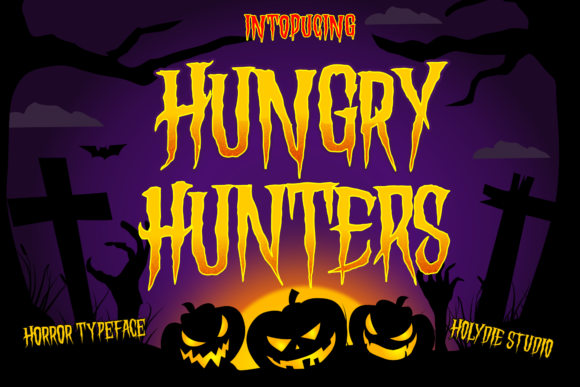
Typography is rarely described as visceral—but Hungry Hunters defies convention. It doesn’t just sit on the page; it leans in, breathes unevenly, and leaves faint smudges of ink like claw marks across your layout. This isn’t a digitally polished, algorithmically smoothed typeface. Hungry Hunters is handmade horror: a font born from physical tools, deliberate imperfection, and an unflinching commitment to atmospheric authenticity. Its value lies not in versatility for every use, but in its singular, potent ability to evoke dread—grounded, tactile, and unmistakably human.
How Hungry Hunters Is Made—and Why That Matters
Most display fonts begin in vector software, refined over dozens of iterations until every curve feels “just right.” Hungry Hunters takes the opposite path. It originates in the studio: hand-drawn with brush pens, chipped markers, or even carved into wood or linoleum before being scanned at high resolution. Each character carries the weight of its making—the slight tremor in a serif, the uneven thickness of a stroke, the subtle bleed where ink soaked just a fraction too deep into paper.
This process yields something rare in digital typography: organic inconsistency. Letters don’t repeat identically. A capital “A” might appear with a heavier left stroke in one context and a ragged baseline in another—not as a bug, but as a feature. These variations aren’t random noise; they mirror how real signage ages, how spray-paint fades at the edges, how chalk cracks on a damp sidewalk. That fidelity creates immediate psychological resonance. Viewers don’t just read the word—they sense its history, its environment, its implied narrative.
Where Hungry Hunters Earns Its Place (Beyond Halloween)
Yes, Hungry Hunters is perfect for Halloween crafts. But reducing it to seasonal decoration overlooks its deeper utility. Its strength emerges where emotional tone must be communicated before a single word is parsed—where atmosphere precedes information.
- Independent film posters: A low-budget thriller doesn’t need glossy polish—it needs unease. Hungry Hunters on a distressed background signals genre instantly, aligning visual language with story intent without relying on clichéd imagery.
- Experiential retail signage: Escape rooms, haunted attractions, or immersive theater venues use Hungry Hunters for wayfinding or room titles. Its texture reinforces physical presence—making a hallway feel narrower, a door feel heavier, a warning feel more urgent.
- Educational materials on folklore or gothic literature: When teaching Mary Shelley or Shirley Jackson, using Hungry Hunters in chapter headers or quote callouts subtly cues students to tonal expectations—not as gimmick, but as contextual scaffolding.
- Small-batch apparel design: T-shirts, tote bags, or enamel pins featuring Hungry Hunters avoid the fatigue of overused “horror fonts.” Its handmade quality signals intentionality, appealing to audiences who value craft over mass replication.
What ties these uses together isn’t subject matter—it’s audience readiness. Hungry Hunters assumes the viewer is already primed for ambiguity, discomfort, or layered meaning. It works because it refuses neutrality.
Designing With Intention: Practical Considerations
Using Hungry Hunters effectively demands restraint and awareness—not just aesthetic choice. Unlike system fonts optimized for legibility at small sizes, Hungry Hunters thrives in controlled environments. Here’s what practitioners consistently observe:
Size and Spacing Are Non-Negotiable
At under 36pt, details blur and texture collapses into visual noise. For body text? Not viable. But at 60–120pt, with generous letter-spacing (tracking +50 to +120) and line-height adjusted to prevent stroke collisions, its rhythm becomes hypnotic. Designers report that pairing it with a clean, neutral sans-serif (like Inter or Source Sans Pro) for supporting text creates powerful contrast—clarity framing chaos.
Color Choices Amplify Subtext
Black-on-white delivers stark, clinical dread—think asylum records or forensic reports. Deep forest green or dried-blood burgundy evokes decay and age. Off-whites (ivory, oat, parchment) suggest yellowed paper or forgotten documents. Neon orange or toxic lime, while eye-catching, often undermines its handmade gravity unless deliberately ironic (e.g., a satirical “zombie apocalypse survival guide”).
Background Texture Must Collaborate—Not Compete
A smooth gradient or solid color lets Hungry Hunters dominate. But layer it over heavy grunge textures, busy patterns, or low-contrast photos, and legibility fractures. Successful implementations often use subtle grain overlays (10–15% opacity), faint watercolor bleeds, or matte paper scans—textures that echo the font’s origin without fighting it.
Who Benefits Most From This Kind of Typography?
Hungry Hunters resonates strongest with creators who understand that type is never silent. Its users fall into overlapping circles:
- Independent filmmakers and producers building authentic micro-budget identities—where every asset must multitask emotionally and economically.
- Graphic designers serving niche cultural clients, such as local theaters staging Gothic adaptations or museums curating dark history exhibits.
- Educators in visual communication, art therapy, or media studies who use type as a case study in semiotics—how form encodes feeling, how craft influences perception.
- Small business owners in experiential sectors: escape room operators, indie bookstore event coordinators, tattoo studios specializing in illustrative horror themes.
- Hobbyists and makers creating personalized decor—hand-stamped signs, custom candle labels, or zine covers—where the font’s handmade roots mirror their own process.
What unites them is a shared priority: meaningful differentiation. In saturated markets—from Etsy shops to film festivals—Hungry Hunters offers distinction rooted in craft, not trend-chasing.
Comparing Intent, Not Just Appearance
It’s tempting to compare Hungry Hunters to other “scary” fonts—Bleeding Cowboys, Creepster, or even classic Blackletter revivals. But those comparisons miss the point. Bleeding Cowboys relies on exaggerated drips; Creepster leans into cartoonish spookiness; Blackletter carries centuries of ecclesiastical and heraldic baggage.
Hungry Hunters operates differently. It doesn’t shout “monster.” It whispers “something watched you walk down this hall last night.” Its horror is ambient, environmental, and psychologically grounded. Where others signal genre through exaggeration, Hungry Hunters suggests it through erosion—of control, of certainty, of pristine surfaces. That makes it less suitable for parody and more potent for sincerity.
Real-World Observations From Practitioners
Design teams integrating Hungry Hunters report consistent patterns:
- Initial hesitation, then rapid adoption: Clients often pause when first seeing mockups—“Is this *too* much?” Within 48 hours, most reverse course after testing against alternatives. The font’s confidence becomes contagious.
- Increased engagement on physical touchpoints: A local haunted trail reported 27% longer dwell time at Hungry Hunters–branded photo ops versus previous typography. Visitors touched the signage, commented on texture, and photographed the letterforms themselves.
- Stronger brand recall in low-attention contexts: At crowded conventions, booths using Hungry Hunters in banners saw higher return traffic—even when competing with louder, brighter displays. Its distinctiveness cut through visual noise without volume.
- Unexpected cross-disciplinary resonance: A neuroscientist studying threat perception used Hungry Hunters in stimulus slides—and found participants registered heightened amygdala response versus standard fonts, confirming its visceral impact beyond subjective preference.
When Hungry Hunters Isn’t the Right Choice
Responsible use means recognizing limits. Avoid Hungry Hunters when:
- Clarity is non-negotiable (e.g., safety instructions, medication labels, accessibility-critical interfaces).
- The audience includes readers with dyslexia or low vision—its irregular forms and tight counters hinder rapid decoding.
- The project demands timeless neutrality (corporate annual reports, academic journals, government documentation).
- Brand voice prioritizes warmth, approachability, or playful whimsy—Hungry Hunters’ inherent tension contradicts those goals.
Its power is contextual. Like a perfectly aged bourbon or a well-worn leather journal, Hungry Hunters earns respect not by being universally palatable, but by being uncompromisingly itself.
Looking Beyond the Spooktacular
What endures about Hungry Hunters isn’t its seasonal appeal—it’s its quiet rebellion against homogenized digital aesthetics. In an era of AI-generated assets and template-driven design, it insists on the value of the human hand: its slips, its pressure shifts, its refusal to erase evidence of labor. It reminds us that fear, like beauty, is often most potent when it feels earned—not manufactured, but discovered in the grain of the real.
Whether you’re printing a limited-run poster for a midnight screening, designing signage for a community ghost tour, or illustrating a thesis on horror semiotics, Hungry Hunters offers more than style. It offers a vocabulary—one written not in code, but in charcoal, ink, and undeniable presence.