Medioha: The Handwritten Display Font That Brings Warmth, Personality, and Versatility to Every Design Project
Imagine opening a hand-written invitation that feels personal, authentic, and full of charm — not because it’s literally handwritten, but because the font used carries the same organic flow, subtle imperfections, and expressive energy of human penmanship. That’s the power behind Medioha: a brand-new handwritten display font designed with intention, artistry, and real-world usability in mind.
What Is Medioha — And Why Does It Stand Out?
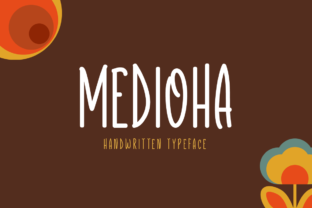
Medioha is more than just another script font. It’s a carefully crafted handwritten display typeface — meaning it’s optimized for prominent, eye-catching uses (like headlines, logos, or banners), not long-form body text. Unlike overly decorative or hard-to-read scripts, Medioha strikes a thoughtful balance: it retains the natural rhythm and variation of real handwriting while ensuring exceptional legibility and visual harmony.
Every curve, loop, and terminal was drawn by hand first — then digitized, refined, and tested across multiple platforms and sizes. The result? A font family with consistent spacing, balanced weight distribution, and intelligent OpenType features (such as contextual alternates and ligatures) that make each word feel uniquely alive — never robotic or repetitive.
Designed for Real-World Use — Not Just Aesthetic Appeal
One common misconception about handwritten fonts is that they’re only suitable for “cute” or “whimsical” projects — think baby shower invites or café chalkboard menus. But Medioha breaks that stereotype. Its versatility stems from its intentional design philosophy: authenticity without sacrificing professionalism.
Whether you're a small business owner crafting your first logo, a graphic designer building a music album cover, or a teacher designing classroom posters, Medioha adapts seamlessly. Its warm, approachable tone builds instant connection — a crucial advantage in today’s crowded digital landscape where trust and relatability drive engagement.
Where Medioha Truly Shines: 10+ Practical Applications
Medioha isn’t built for one niche — it’s engineered for breadth and impact. Here’s how it elevates everyday creative work:
- Stationery & Greeting Cards: Adds sincerity and personality to wedding invitations, thank-you notes, or holiday cards — helping your message feel heartfelt, not generic.
- Logos & Brand Identity: Perfect for lifestyle brands, artisanal shops, wellness studios, or boutique services that want to communicate care, craftsmanship, and human-centered values.
- T-Shirt & Apparel Design: Stands out on fabric with confident strokes and generous x-height — ideal for slogans, band merch, or limited-edition drops.
- Paper & Print Design: Performs beautifully in letterpress, foil stamping, or offset printing thanks to its clean vector outlines and generous counters (the open spaces inside letters like ‘a’ or ‘e’).
- Website Headers & Hero Banners: Captures attention instantly on landing pages, portfolio sites, or creative agency homepages — especially when paired with minimalist sans-serif body text for contrast.
- Photo Frames & Social Media Graphics: Enhances visual storytelling by adding emotional texture — imagine Medioha overlaid on a soft-focus travel photo or a vintage-style Instagram post.
- Flyers & Event Posters: Helps local businesses, galleries, or community centers stand out in physical and digital spaces — conveying creativity and approachability at a glance.
- Music Album Covers: Complements indie, folk, lo-fi, or acoustic genres by evoking intimacy and authenticity — no auto-tuned typography here.
- Posters & Art Prints: Works equally well as a focal headline or subtle accent, supporting both bold statements and quiet elegance.
- Image Sliders & Digital Ads: Renders crisply at any resolution, making it ideal for responsive web design and cross-device campaigns.
Why Legibility Matters — Even in Handwritten Fonts
A frequent concern among designers and non-designers alike is whether a handwritten font will be “too hard to read.” Medioha addresses this head-on. While many script fonts sacrifice clarity for flair — connecting letters too tightly or using excessive swashes — Medioha prioritizes functional beauty.
Its generous letter spacing (tracking), moderate slant, and distinct character shapes ensure readability even at smaller sizes or on low-resolution screens. For example, the lowercase ‘a’, ‘g’, and ‘s’ are deliberately differentiated — avoiding the confusion that plagues many casual scripts. This makes Medioha not just beautiful, but inclusive: accessible to readers with dyslexia, visual impairments, or those scanning quickly on mobile devices.
How Medioha Fits Into Modern Creativity & Communication
In an age dominated by AI-generated content, algorithmic feeds, and mass-produced templates, audiences are craving human signals. Handwriting — even digitally rendered — serves as a subtle yet powerful cue: This was made by a person, for people.
Medioha taps into that psychological need. Studies in marketing and behavioral design show that consumers perceive handwritten elements as more trustworthy, empathetic, and memorable. When used thoughtfully, Medioha doesn’t just decorate — it communicates intention, warmth, and care.
It also empowers creators at every level. You don’t need advanced typography training to use Medioha effectively. Its intuitive structure and wide language support (including Latin-based European languages and extended diacritics) make it beginner-friendly — yet sophisticated enough for professional studios and branding agencies.
Common Misconceptions — Clarified
- “Handwritten fonts are unprofessional.” Not true — context matters. Medioha’s clean execution and restrained flourishes make it ideal for premium brands, educational institutions, and healthcare practices seeking approachability without sacrificing authority.
- “It only works in serif or sans-serif pairings.” Medioha pairs beautifully with a wide range of typefaces — from geometric sans-serifs like Inter or Manrope, to elegant serifs like Playfair Display, and even monospaced fonts for creative contrast.
- “I need special software to use it.” No — Medioha is delivered in standard .OTF and .TTF formats, compatible with Adobe Creative Cloud (Photoshop, Illustrator, InDesign), Figma, Canva, Affinity Suite, and most modern operating systems.
Getting Started With Medioha: Tips for Best Results
- Use it for emphasis, not exposition. Reserve Medioha for headlines, quotes, callouts, or short phrases — not paragraphs.
- Pair wisely. Contrast Medioha’s organic flow with a clean, neutral typeface for body text. Avoid competing scripts or overly decorative fonts.
- Test at scale. Preview your design on both desktop and mobile. Medioha shines at 36pt+, but also holds up well at 24–28pt for subheads.
- Leverage OpenType features. Enable contextual alternates in your design app to unlock natural letter variations — giving each word a subtly unique rhythm.
- Respect hierarchy. Let Medioha lead, then step back. Its strength lies in presence — not persistence.
Final Thought: More Than a Font — A Creative Ally
Medioha isn’t just another download in your font library. It’s a tool for human-centered design — one that helps bridge the gap between digital efficiency and emotional resonance. Whether you're launching a new brand, designing a heartfelt gift, or simply trying to make your next project feel more genuine, Medioha offers the warmth of handwriting with the reliability of modern typography.
In a world that often moves too fast, Medioha reminds us that the most impactful communication still begins with the human touch — even when it’s expressed through pixels and vectors.