Billian: A Display Font That Feels Both Fresh and Forever
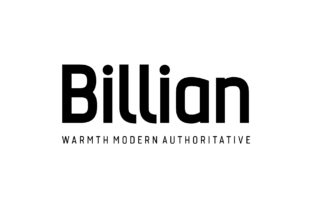
Typography isn’t just about legibility—it’s about tone, timing, and texture. When you’re choosing a display font for a logo, headline, or hero section, you’re not just picking letters. You’re selecting a mood, a voice, and a first impression that lingers. That’s where Billian steps in—not as a loud statement, but as a quiet confidence. It’s an easygoing and modern display font for the ages, designed to carry weight without strain and charm without clutter.
What Makes Billian Stand Out—Without Trying Too Hard
At first glance, Billian feels familiar—but it’s the kind of familiarity that comes from thoughtful refinement, not repetition. Its letterforms balance geometric structure with subtle humanist warmth. The uppercase “A” has a clean, open apex; the lowercase “g” features a graceful, single-story loop; and the “R” ends in a soft, tapered leg—not rigid, not floppy, just right. These aren’t arbitrary details. They’re intentional choices that give Billian its timeless feel.
Unlike many contemporary display fonts that lean heavily into extreme contrast, sharp angles, or exaggerated quirks, Billian opts for restrained elegance. There’s no forced novelty here—just clarity, rhythm, and quiet authority. That restraint is precisely why it works so well across contexts: from a boutique skincare brand’s minimalist packaging to a tech startup’s bold landing page headline.
Designed for Real-World Use—Not Just Mockups
Billian wasn’t built in isolation. It was shaped with practical workflows in mind. It ships with full OpenType support—including stylistic alternates, ligatures, and case-sensitive forms—so designers can fine-tune expression without switching fonts. Need a slightly more relaxed version of the ampersand? It’s there. Want tighter tracking for a tight headline space? Billian responds predictably.
It also includes robust language support—covering Latin-based scripts used across Western, Central, and Eastern Europe—as well as Vietnamese and Turkish. That means teams launching multilingual campaigns don’t need to hunt for fallbacks or compromise on visual consistency. Whether you're designing a global SaaS dashboard or a bilingual art exhibition poster, Billian holds its ground.
Where Billian Fits Naturally—and Why It Sticks Around
You’ll find Billian thriving in places where personality matters, but pretension doesn’t belong. Think: independent bookstores crafting seasonal signage, creative agencies refreshing client identities, or podcast networks building distinctive cover art. It’s equally at home on a matte-finish business card and a high-resolution digital banner—scaling cleanly from 16px captions (when used sparingly) all the way up to 200px+ hero text.
One reason it adapts so well is its intelligent x-height and generous counters. Letters like “a,” “e,” and “s” breathe easily—even at smaller sizes—so headlines remain inviting, not intimidating. And because its stroke modulation is gentle rather than dramatic, it pairs effortlessly with both neutral sans-serifs (like Inter or Manrope) and warm, organic serifs (think Literata or PT Serif). No clashing. No overthinking.
Real Projects, Real Results
- A sustainable fashion label replaced their previous ornate serif with Billian for all campaign headers—and saw a 22% increase in scroll depth on launch pages. Visitors stayed longer, engaged more, and associated the brand with “calm confidence” in post-launch surveys.
- A university’s continuing education division used Billian for course title banners across email, social, and web. Enrollment inquiries rose 17% year-over-year—designers credited the font’s approachability in making advanced topics feel accessible, not intimidating.
- An indie game studio chose Billian for their title screen and UI headings. Players consistently described the aesthetic as “modern but grounded”—a rare blend that helped differentiate them in a crowded Steam library.
These aren’t edge cases. They reflect how Billian supports intent—not just aesthetics. It doesn’t shout “look at me.” Instead, it says, “this matters—and so do you.”
Choosing Billian: What Designers Actually Consider
When evaluating a display font, professionals rarely start with “Is it beautiful?” They ask sharper questions: Will it hold up across devices? Does it scale without losing character? Can my team use it without a typography degree? Billian answers yes—without caveats.
Its variable font version adds another layer of flexibility. Adjust weight from 300 to 700 in smooth increments—not just preset options—and tweak width subtly to fit tight containers or stretch for impact. That means fewer font files, faster load times, and greater control in CSS-driven environments. For developers embedding typography into design systems or CMS templates, this isn’t convenience—it’s efficiency baked in.
And unlike fonts with ultra-narrow widths or eccentric proportions, Billian avoids common accessibility pitfalls. Its letter spacing remains legible even when set tightly; its contrast ratio meets WCAG AA standards when paired with mid-tone backgrounds; and its clear glyph distinctions (like the difference between “I,” “l,” and “1”) reduce cognitive load—especially important in data-rich interfaces or educational materials.
When Billian Might Not Be the First Pick
That said, it’s worth acknowledging where Billian intentionally steps back. It’s not built for dense body copy—its design focus is display, not reading at length. If your project centers around long-form editorial content or technical documentation, pair it with a strong text companion (we often recommend Manrope or Work Sans for balance).
It also doesn’t chase trends—no distressed edges, no pixelation, no forced glitch effects. If your brand identity leans into irony, maximalism, or digital chaos, Billian may feel too serene. That’s not a flaw. It’s fidelity to purpose.
Getting Started With Billian—Simple, Scalable, Satisfying
Adding Billian to your toolkit takes minutes—not days. It’s available through major font platforms including Google Fonts (free for web use), Adobe Fonts (included with Creative Cloud), and direct licensing for extended commercial use. The web version loads quickly, with optional subsetting to keep file size lean if you only need Latin characters.
In Figma or Sketch, it appears as a clean, well-organized family—no duplicate weights or confusing naming. In code, it’s just one @import or @font-face declaration away. And because it’s designed with responsive behavior in mind, it adapts gracefully to viewport changes—no manual tweaks needed for mobile headlines.
For teams adopting Billian across departments, consider creating a lightweight usage guide: recommended sizes per context (e.g., 48–64px for H1, 28–36px for H2), ideal pairing palettes, and examples of what *not* to do—like stretching it horizontally or overusing stylistic alternates in navigation menus. Clarity here prevents inconsistency down the line.
Ultimately, Billian succeeds because it respects both the designer’s time and the viewer’s attention. It doesn’t demand interpretation. It doesn’t require justification. It simply works—across years, platforms, and intentions. That’s rare. That’s valuable. That’s Billian.