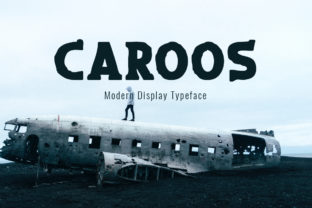
Caroos: A Modern Display Font Designed for Clarity, Character, and Real-World Use
Typography is no longer just about legibility—it’s about intention. In a world where attention is fragmented across devices, platforms, and formats, the fonts we choose carry quiet but powerful messages: about tone, trust, and taste. Caroos arrives at precisely this moment—not as another decorative novelty, but as a thoughtfully engineered display font built for versatility without compromise. It’s clean enough for a minimalist brand identity, expressive enough for a concert poster, and balanced enough to hold its own on both screen and paper.
What Makes Caroos Distinct—Beyond Aesthetics
Caroos isn’t defined by extreme contrast or exaggerated quirks. Instead, it balances geometric precision with subtle humanist warmth—notice the gently flared terminals on uppercase letters, the open apertures in ‘a’, ‘e’, and ‘s’, and the consistent rhythm of spacing that supports readability even at larger sizes. These aren’t stylistic flourishes added for effect; they’re functional decisions rooted in how people actually read and process visual information today.
Unlike many display fonts that sacrifice functionality for flair, Caroos was designed with real-world constraints in mind: variable weight options for hierarchy, robust character sets supporting multilingual projects, and optical sizing considerations that ensure consistency across print and digital contexts. That means a logo set in Caroos looks intentional whether it’s laser-etched onto a notebook spine or scaled down for a mobile app header.
Why Display Fonts Matter More Than Ever
Display fonts occupy a critical role in modern communication—not as background players, but as primary identifiers. Think of the first impression your business makes on a landing page, the emotional resonance of a music album cover, or the tactile credibility of a letterpress wedding invitation. In each case, the typeface sets expectations before a single word is read.
This shift reflects broader changes in how people consume content. With social feeds favoring bold visuals and short-form storytelling, typography has become part of the image itself. A well-chosen display font like Caroos helps creators cut through noise not by shouting louder, but by speaking more clearly—and memorably.
Fitting Into Evolving Creative Workflows
Today’s designers, marketers, and small business owners rarely work in silos. A single project might begin as a Canva mockup, move into Figma for team feedback, then translate into a Shopify banner, a printed flyer, and an Instagram story—all within 48 hours. That pace demands tools that adapt, not resist.
Caroos supports that reality. Its OpenType features include stylistic alternates, ligatures, and case-sensitive forms—useful for refining polish in professional design tools—while its straightforward naming and clean file structure make it equally accessible in beginner-friendly editors. No complex installation steps, no missing glyphs mid-project. Just reliable performance, across platforms and skill levels.
Where Caroos Fits Naturally—And Where It Surprises
Stationery remains one of the most compelling applications for Caroos—not because it’s nostalgic, but because physical touchpoints are regaining value. In an era of digital fatigue, a beautifully typeset thank-you card or branded notepad signals care and continuity. Caroos’ generous x-height and moderate stroke contrast ensure clarity when printed at small sizes, while its confident presence shines on oversized posters or gallery wall text.
But it’s also thriving in unexpected places. Educators use it for classroom signage that feels contemporary yet approachable. Freelance photographers pair it with editorial layouts to add quiet authority without visual competition. Indie musicians apply it to Bandcamp covers where authenticity matters more than trend-chasing—and where Caroos’ restrained elegance avoids cliché.
Even in web headers, Caroos performs with intention. When paired with a neutral sans-serif body font (like Inter or Manrope), it creates clear visual hierarchy without overwhelming users. And because it’s optimized for modern web font delivery—light file size, WOFF2 support, and fallback-ready CSS—it loads quickly and renders crisply on high-DPI screens.
Practical Considerations for Everyday Users
You don’t need a design degree to benefit from Caroos—but understanding a few practical principles helps you use it effectively:
- Reserve it for emphasis: Display fonts shine when used sparingly. Apply Caroos to headlines, logos, or key calls-to-action—not body copy.
- Test contrast early: While Caroos works well on light and dark backgrounds, always verify legibility at actual usage sizes—especially for t-shirts or outdoor flyers where lighting and viewing distance vary.
- Pair intentionally: Its balanced proportions make it highly compatible with both geometric and humanist sans-serifs. Avoid pairing with other display fonts unless there’s strong conceptual alignment.
- Consider licensing scope: If you’re using Caroos across client work, check whether your license covers commercial redistribution—especially for templates, themes, or SaaS platforms.
Not Just Another Trend—A Tool for Thoughtful Expression
It’s easy to overlook type as infrastructure—something that simply “needs to be there.” But the rise of self-publishing, micro-brands, and creator-led businesses has elevated typography from utility to signature. People recognize voices faster than ever, and Caroos gives them a voice that feels both current and grounded.
This isn’t about chasing what’s viral. It’s about choosing a tool that aligns with how you want to be perceived: professional but personable, modern but not fleeting, distinctive without being difficult. That balance is rare—and harder to achieve than it looks.
Real Projects, Real Results
A Brooklyn-based stationery studio adopted Caroos for their seasonal greeting card line. Previously using a mix of free fonts, they found inconsistent spacing and limited language support hindered expansion into bilingual markets. Switching to Caroos streamlined production, improved print accuracy, and gave customers a cohesive visual thread across product categories—from foil-stamped envelopes to digital e-cards.
A university communications team used Caroos for a campus-wide sustainability campaign. They needed something that felt forward-looking but trustworthy—no sci-fi sterility, no retro gimmicks. Caroos delivered clarity in large-format banners and subtle distinction in email subject lines, helping the initiative stand out without feeling promotional.
Even individual creators report tangible benefits: a freelance illustrator uses Caroos for her portfolio site header, noting that visitors spend more time on her “About” page since the typography feels inviting rather than intimidating. A podcast host chose it for episode thumbnails—finding that listeners describe the show’s aesthetic as “clear, calm, and confident,” words she hadn’t explicitly stated in her branding brief.
Moving Forward—With Intention, Not Just Novelty
Caroos doesn’t promise transformation. It offers refinement—a way to elevate existing work without overhauling systems or learning new workflows. That’s increasingly valuable as professionals juggle multiple roles, tighter deadlines, and higher expectations for visual coherence.
Its relevance lies not in being “the next big thing,” but in meeting current needs: responsive design, cross-platform consistency, inclusive language support, and aesthetic flexibility. It’s a response—not to algorithm updates or platform shifts—but to the enduring human desire for communication that feels both considered and effortless.
Whether you’re launching a side hustle, redesigning your teaching materials, or refreshing your studio’s visual identity, Caroos serves as a quiet collaborator—supporting your message rather than competing with it. And in a landscape crowded with noise, that kind of thoughtful utility is anything but ordinary.