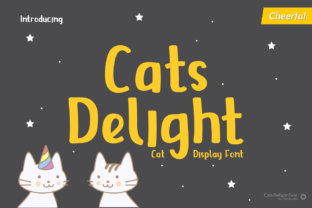
Cats Delight
Cats Delight is a display font designed with intention—not just charm. Its playful curves, gentle bounce, and whimsical yet legible structure make it more than a decorative choice. It’s a strategic tool: one that signals warmth, approachability, and lighthearted confidence. When used deliberately, Cats Delight supports communication goals that hinge on emotional resonance—especially where trust, relatability, or joyful differentiation matter.
Why Strategic Use Matters More Than Aesthetic Appeal
A font like Cats Delight doesn’t exist in isolation. Its value emerges only when aligned with purpose, audience, and context. For a small business launching a line of organic pet treats, Cats Delight on packaging can reinforce brand personality—friendly, caring, unhurried—without needing explanatory copy. But for a financial advisory firm publishing quarterly market reports, the same font would undermine credibility before the first sentence is read. The risk isn’t in the font itself; it’s in applying it without evaluating what message you’re actually sending—and whether that message serves your goal.
That’s why thoughtful adoption starts with clarity: What outcome do you want this design to support? Is it to soften a technical explanation for educators? To make a children’s literacy app feel inviting? To differentiate a handmade soap brand in a crowded Etsy storefront? Each of those scenarios benefits from different typographic decisions—and Cats Delight fits some, not all.
Where Cats Delight Adds Real Value
Cats Delight excels in controlled, high-impact roles—not body text, not dense interfaces, but moments where tone carries equal weight to content. Consider these grounded use cases:
- Branded social assets: A wellness coach’s Instagram carousel introducing “5 Gentle Morning Rituals” gains visual cohesion and emotional alignment when Cats Delight headlines each tip—reinforcing calm intentionality without clichéd stock imagery.
- Event invitations and digital announcements: A community library hosting a “Storytime Under the Stars” night uses Cats Delight for the event title and date. The font quietly communicates that this isn’t formal instruction—it’s shared wonder, accessible to families and newcomers alike.
- Product labeling for lifestyle brands: A ceramicist selling hand-thrown mugs with illustrated cat motifs pairs Cats Delight with clean sans-serif body text. The contrast honors craftsmanship (serious skill) while inviting warmth (playful spirit)—a balanced positioning that resonates with buyers who value both authenticity and joy.
- Educational materials for younger audiences: A freelance illustrator creating printable emotion cards for elementary counselors uses Cats Delight for the feeling names (“Brave,” “Calm,” “Curious”). Its open letterforms aid early recognition, and its friendly rhythm reduces cognitive load during emotional learning.
In each case, Cats Delight isn’t chosen because it’s “cute”—it’s chosen because it advances a specific communication objective. That distinction separates effective typography from decorative impulse.
How to Approach Cats Delight With Intention
Start by auditing your current visual language. Where do you already signal warmth or playfulness? Is that consistent across touchpoints—or does it appear randomly, diluting impact? If you’re considering Cats Delight, ask yourself:
- What’s the primary action I want the viewer to take after seeing this? (e.g., sign up, pause and reflect, smile and share, recognize a brand instantly)
- Who needs to feel welcomed or reassured here—and what cues do they rely on?
- What other fonts, colors, or layouts are present? Does Cats Delight complement them—or compete?
- Is this a one-time application or part of a longer-term system? If recurring, how will you maintain consistency without monotony?
For example, a blogger writing about mindful parenting might use Cats Delight sparingly: only for newsletter subject lines and chapter headers in downloadable guides. Body text remains highly legible (e.g., Inter or Lora), preserving readability across devices. That restraint ensures Cats Delight retains its emotional weight—rather than fading into background noise.
Planning Tips for Long-Term Typographic Health
Fonts shape perception over time. Repeated exposure to Cats Delight in specific contexts builds subconscious associations: “This brand feels safe,” “This resource won’t overwhelm me,” “I can relax here.” But that only works if usage is predictable and purposeful.
Build simple guidelines—even informal ones—for yourself or your team:
- Reserve Cats Delight for display roles only: Headlines, logos, callout quotes, and short labels. Never for paragraphs, captions under complex charts, or forms requiring precise scanning.
- Pair it intentionally: It balances best with neutral, humanist sans-serifs (like Nunito, Poppins, or Manrope) or low-contrast serifs (like Merriweather or Cormorant Garamond). Avoid clashing styles—no ultra-bold grotesques or tightly spaced monospaced fonts alongside it.
- Test at real size and context: View Cats Delight on mobile screens, printed postcards, and projected slides. Letter spacing that looks charming at 48pt may collapse at 24pt. Kerning adjustments often help—especially around “A”, “V”, and “W” combinations.
- Consider accessibility early: While Cats Delight meets basic contrast requirements at larger sizes, its decorative details reduce legibility for some readers with dyslexia or low vision. Always provide fallbacks in your CSS stack and avoid relying solely on visual tone to convey meaning.
Risks of Using Cats Delight Without Strategy
When deployed without clear intent, Cats Delight can unintentionally signal unseriousness, lack of polish, or misalignment with audience expectations. A nonprofit advocating for animal welfare might choose it for their youth education program—but using it across their annual impact report could unintentionally undercut the gravity of their data and policy work.
Another common pitfall: overuse across platforms. Seeing Cats Delight on a website banner, email header, Instagram bio, and product tags creates visual fatigue—not delight. The brain stops registering the warmth and starts registering repetition. That’s not branding; it’s redundancy.
Also consider cultural and contextual nuance. In some professional environments—healthcare compliance, legal tech, academic publishing—the very qualities that make Cats Delight endearing elsewhere may read as incongruent. That’s not a flaw in the font; it’s a mismatch in framing. Your job isn’t to force fit—it’s to assess fit.
Making Better Decisions, Not Just Better-Looking Designs
Typography is decision-making made visible. Every font choice reflects assumptions about audience attention, message priority, and desired emotional response. Cats Delight invites you to ask sharper questions: What feeling must precede understanding? Where does lightness serve clarity—and where does it obscure substance?
That mindset shifts focus from “Does this look nice?” to “Does this serve the person on the other side of the screen—or page—or package?” It turns aesthetic selection into empathetic strategy.
So before adding Cats Delight to your next project, pause. Name the goal. Name the person. Name the moment you hope to influence. Then decide—not based on trend, but on alignment. Because the most cheerful fonts don’t just make things prettier. They make intentions clearer, connections warmer, and outcomes more likely.