Enough Font: Why This Retro Typeface Is Reshaping Modern Brand Identity
In an era defined by algorithmic precision, variable fonts, and AI-generated design systems, a surprising trend is gaining momentum among forward-thinking professionals: the intentional return to analog-inspired typography. At the center of this shift is Enough — a meticulously crafted retro font family that doesn’t merely mimic mid-century aesthetics but reinterprets them with contemporary rigor. Designed with authenticity and usability in mind, Enough stands apart not as nostalgia bait, but as a functional, expressive tool built for today’s branding, editorial, and digital product needs.
What Exactly Is Enough?
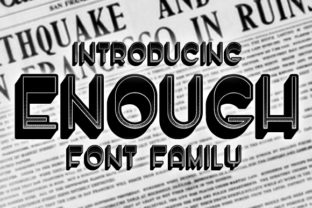
Enough is a cohesive type system comprising serif, sans-serif, and display variants — all unified by shared proportions, rhythm, and character. Its DNA is unmistakably rooted in the 1950s and early 1960s: think clean geometric structures, subtle stroke modulation, open apertures, and a gentle humanist warmth that avoids sterile uniformity. Unlike many “vintage” fonts that rely on exaggerated quirks or distressed textures, Enough achieves its retro distinction through disciplined restraint — balanced x-heights, generous spacing, and letterforms that breathe on screen and in print alike.
Crucially, Enough was developed with modern technical standards in mind. It includes full OpenType support, multilingual character sets (including extended Latin, IPA, and currency symbols), optical sizing variants, and robust hinting for crisp rendering across devices. This isn’t a scanned-and-traced relic — it’s a purpose-built typeface engineered for performance, accessibility, and scalability.
Why Retro Typography Is No Longer Just for Throwback Campaigns
The resurgence of mid-century design language — from Swiss grid layouts to Memphis-inspired color blocking — reflects deeper shifts in how professionals communicate value. In a marketplace saturated with hyper-polished, generically “modern” visuals, authenticity has become a competitive differentiator. Consumers and clients alike are increasingly attuned to cues of intentionality: hand-drawn elements, tactile textures, and typography that signals craft over convenience.
Enough meets this demand precisely because it avoids caricature. Its forms recall iconic design moments — the confident clarity of Helvetica’s predecessors, the editorial warmth of Times New Roman’s contemporaries — without locking users into a single stylistic lane. A marketer launching a heritage-focused wellness brand can use the Enough Serif for editorial storytelling; a SaaS founder building a no-nonsense productivity tool might choose Enough Sans for interface labels and dashboard headings; a freelance designer crafting a boutique restaurant identity could deploy Enough Display for menu headers and signage — all while maintaining visual continuity and tonal coherence.
Changing Workflows Demand Typographic Flexibility
Today’s creators rarely work in silos. A single project may span social media assets, responsive web interfaces, printed collateral, video subtitles, and email campaigns — often within tight timelines and lean teams. Generic system fonts lack distinctiveness; overly decorative retro fonts break down at small sizes or fail accessibility checks. Enough bridges that gap.
- For developers: Its well-structured CSS font stacks and variable-axis options enable dynamic typographic scaling without bloating page weight.
- For designers: The family’s consistent metrics mean switching between weights or styles rarely requires reflowing layouts — a critical time-saver in Figma or Adobe XD.
- For marketers: Its high legibility at low resolutions ensures campaign headlines remain clear on Instagram Stories, TikTok overlays, and mobile ads — where attention spans measure in milliseconds.
This operational fluency explains why Enough is appearing in brand guidelines across sectors — from independent publishing houses embracing tactile editorial identities to B2B fintech platforms seeking to soften perceived complexity with approachable authority.
More Than Aesthetic: How Enough Aligns with Evolving Consumer Expectations
Research consistently shows that consumers associate thoughtful typography with trustworthiness and competence. A 2023 study by the Design Management Institute found that brands using custom or carefully curated type systems saw a 22% higher recall rate in controlled testing — especially when those systems conveyed both clarity and character. Enough delivers both: its geometry conveys structure and reliability, while its subtle irregularities (a softly tapered terminal, a gently angled bracket) signal humanity and care.
This duality resonates powerfully in post-pandemic professional culture. Entrepreneurs and freelancers are no longer just selling services — they’re curating experiences, values, and relationships. A logo set in Enough Display communicates confidence without coldness; body text set in Enough Serif invites sustained reading without demanding effort. It’s typography that works *with* the reader, not against them.
Real-World Adoption: Beyond the Obvious
It’s easy to imagine Enough in coffee shop signage or vinyl record packaging — and it excels there. But its growing adoption reveals more nuanced applications:
- Educational platforms are using Enough Sans for course interfaces, citing improved readability during long-form learning sessions — particularly among neurodiverse users who benefit from open counters and reduced visual noise.
- Sustainability-focused startups select Enough Serif for annual reports, aligning its enduring craftsmanship with long-term environmental commitments — a quiet rebuttal to disposable digital aesthetics.
- Remote-first agencies embed Enough in internal design systems, standardizing voice across client decks, Slack notifications, and documentation — reinforcing consistency without sacrificing personality.
These aren’t stylistic experiments. They’re strategic decisions grounded in how people process information, form impressions, and assign meaning to visual language.
Technology Meets Timelessness
The rise of Enough also mirrors broader technological maturation. As variable fonts become mainstream and browser support solidifies, designers no longer need to choose between expressive typography and performance. Enough leverages these advances: its variable axis allows fine-tuned optical adjustments for headings versus captions, and its hinted outlines ensure fidelity on everything from high-DPI retina displays to budget Android tablets.
Moreover, its licensing model — available via subscription and perpetual license — reflects evolving business realities. Freelancers appreciate one-time purchase options; enterprises value scalable deployment rights. There’s no forced SaaS dependency, no usage caps, no opaque attribution requirements. In an industry increasingly wary of vendor lock-in, Enough offers autonomy without compromise.
Looking Ahead: Typography as Strategic Infrastructure
Typography is no longer just about “making things look nice.” It’s infrastructure — shaping how messages land, how interfaces function, how brands scale across touchpoints. Enough succeeds because it treats retro inspiration not as a finish, but as a foundation. Its forms honor design history without being bound by it; its engineering anticipates tomorrow’s constraints without ignoring today’s realities.
For professionals navigating rapid change — whether launching a solo practice, repositioning a legacy brand, or building the next generation of digital tools — choosing Enough signals something essential: that clarity, warmth, and craft remain non-negotiable. Not as relics, but as active, adaptable resources.
As design continues its quiet pivot from novelty-driven iteration to values-driven intention, Enough represents more than a font family. It’s evidence that the most forward-looking choices sometimes begin with looking back — thoughtfully, deliberately, and with enough respect for what came before to build something truly new.