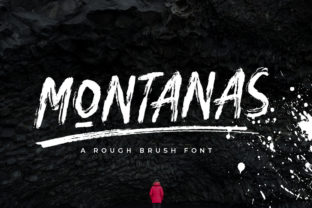
Montanas
Montanas isn’t just another brush font—it’s a deliberate, confident voice in a landscape crowded with overly polished or algorithmically smoothed typefaces. With its hand-drawn texture, rhythmic stroke variation, and unmistakable flow, Montanas balances rawness and clarity in a way few rough brush fonts achieve. It doesn’t try to hide its origins; instead, it leans into the natural imperfections of brushwork—slight tapering, subtle pressure shifts, organic entry and exit points—while maintaining strong legibility and visual cohesion. That duality makes it unusually versatile: equally at home on a minimalist wedding invitation and a bold streetwear tee, a boutique coffee bag and a conference poster.
Why Brush Fonts Like Montanas Are Resonating Now
Over the past five years, digital interfaces have grown increasingly uniform—glass-morphism, system fonts, AI-generated layouts—all prioritizing speed and scalability over distinctiveness. In response, creators and brands are quietly reasserting tactile authenticity. This isn’t nostalgia for analog tools; it’s a functional preference. People respond more readily to human-made cues—subtle irregularities, warmth, intentionality—especially when attention is fragmented and trust is earned through perceived sincerity.
Montanas fits squarely into this shift—not as a retro affectation, but as a pragmatic tool for differentiation. Unlike highly stylized script fonts that sacrifice readability for flair, Montanas preserves strong letterforms and generous spacing. Its lowercase “a,” “g,” and “e” retain classic structure while gaining character through brush weight. Uppercase letters command presence without shouting. That balance matters in real-world use: a small-batch skincare label needs to feel artisanal *and* communicate ingredients clearly; a local bookstore’s event poster must catch the eye *and* remain scannable from six feet away. Montanas delivers both.
From Niche Tool to Cross-Platform Asset
Brush fonts used to be relegated to one-off illustrations or social media graphics—impractical for long text or print consistency. But Montanas was designed with modern production in mind. Its OpenType features include stylistic alternates, ligatures, and multilingual support (including extended Latin characters), making it viable for bilingual packaging, international e-commerce sites, or educational materials where tone and inclusivity matter. Designers report using it not just for headlines, but for short body copy in editorial layouts—particularly in lifestyle blogs, independent magazines, and brand storytelling sections where voice carries equal weight to information.
This evolution reflects broader changes in creative workflows. More freelancers and small studios now handle end-to-end branding—from logo and web design to physical collateral and merch. They need fonts that scale across mediums without requiring custom redraws or workarounds. Montanas works reliably in vector editors, desktop publishing software, and modern CSS environments. Its hinting ensures crisp rendering even at smaller sizes on screen—a practical advantage many brush fonts lack.
Where Montanas Fits in Real Creative Workflows
Consider three common scenarios:
- A freelance graphic designer building an identity for a ceramic studio might pair Montanas with a neutral sans-serif (like Inter or Manrope) for contrast—using the brush font for the studio name and tagline, the sans for product descriptions and care instructions. The combination signals craftsmanship without sacrificing usability.
- An educator developing workshop handouts could use Montanas for section headers and quote callouts. Its clarity helps anchor attention in dense material, while its warmth softens the formality often associated with learning resources—making content feel more approachable, especially for adult learners returning to skill-building.
- A small food producer labeling small-batch hot sauce might apply Montanas to the front label (“Smoked Ancho Reserve”) and keep ingredient lists in a clean mono-spaced font. Shoppers scanning shelves respond faster to the font’s confident rhythm—and later recall the brand more distinctly because of its consistent, unapologetic texture.
In each case, Montanas isn’t performing decorative labor. It’s doing structural work: guiding hierarchy, reinforcing brand values, and supporting comprehension—not competing with it.
Designing With Intention, Not Just Aesthetic
Using Montanas effectively means resisting the temptation to overapply. Its strength lies in contrast and restraint. Pair it thoughtfully: avoid other high-contrast or heavily textured fonts nearby. Let it breathe—generous line height, ample margins, and intentional whitespace amplify its expressiveness rather than dilute it. On packaging, consider how ink coverage interacts with substrate; Montanas’ thick strokes translate well to spot UV, foil stamping, or screen printing, where subtlety can get lost.
It also performs differently across contexts. On apparel, its flow reads well on curved surfaces like t-shirt chests or tote bags—unlike rigid scripts that distort at angles. For digital use, test at multiple weights and sizes: while its regular weight shines in headers and logos, lighter or bolder variants (if available in the family) may better suit subheads or interactive elements like buttons. Always prioritize legibility over novelty—especially for users relying on screen readers or viewing on low-resolution devices.
Looking Ahead: Craft in Context
The future of typography isn’t about choosing between digital precision and handmade charm—it’s about integrating them meaningfully. Montanas exemplifies that integration. It doesn’t simulate imperfection for effect; it embraces the logic of the brush while honoring typographic fundamentals: rhythm, proportion, and function. As generative tools accelerate design output, the value of intentional, human-crafted assets like Montanas increases—not as relics, but as anchors.
That’s why more marketers are specifying Montanas in brand guidelines alongside core colors and imagery principles: it’s not just “how it looks,” but “how it behaves” across touchpoints. Business owners selecting fonts for their first website or product line are asking smarter questions—not just “Is it trendy?” but “Does it reflect our process? Will it age well? Can my team use it consistently without constant oversight?” Montanas answers those questions with quiet reliability.
Practical Next Steps
If you’re evaluating Montanas for a project, start small. Try it in one high-impact place: a logo lockup, a signature quote on a landing page, or the main title on a printed flyer. Compare how it feels against your current font stack—not just visually, but emotionally and functionally. Does it clarify or complicate? Does it invite engagement or demand decoding?
When licensing, check usage rights carefully—some versions include web font kits with variable weight support, others are optimized for desktop-only use. If you’re working with a developer or printer, share the font’s technical specs early: recommended minimum sizes, ideal file formats (OTF vs. WOFF2), and known rendering behaviors across browsers or RIPs.
And remember: Montanas doesn’t need to carry every message. Its power comes from strategic placement—not ubiquity. Use it where voice matters most, where distinction is earned through authenticity, and where clarity and character coexist without compromise.