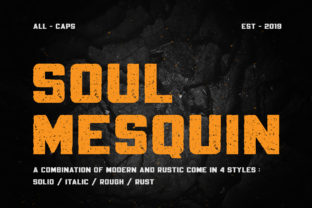
Soul Mesquin: Industrial Strength in Typography
When you see Soul Mesquin, you don’t just read it—you feel its weight. Its all-uppercase, sans serif form hits with the solidity of stamped steel, the clarity of a machined label, the no-nonsense authority of industrial lettering from the mid-20th century. It’s not decorative. It’s declarative. Soul Mesquin isn’t trying to charm—it’s built to endure, communicate instantly, and hold its ground in demanding visual environments.
What Makes Soul Mesquin Distinctive?
At first glance, Soul Mesquin looks deceptively simple: bold, geometric, uniform in stroke, tightly spaced, and strictly uppercase. But simplicity here is precision—not absence of thought. Every character is constructed from clean arcs and straight lines, with near-perfect symmetry and consistent proportions. The ‘O’ is a true circle; the ‘H’ has verticals of equal thickness and a horizontal bar centered with surgical accuracy; even the ‘R’ avoids flourish, opting instead for a compact, grounded leg that echoes structural bracing.
This isn’t accidental minimalism. Soul Mesquin draws directly from functional lettering found on factory equipment, shipping crates, safety signage, and technical schematics—sources where legibility at distance, under poor lighting, or during rapid scanning was non-negotiable. That heritage translates into real-world performance: high contrast between positive and negative space, generous counters (the enclosed areas inside letters like ‘A’ or ‘D’), and open apertures (the openings in ‘C’, ‘S’, or ‘a’) that prevent visual clogging—even at small sizes or low resolutions.
Where Soul Mesquin Excels in Practice
Soul Mesquin thrives where clarity and impact matter more than subtlety. It’s rarely the right choice for body text—but it’s often the perfect solution for headlines, logos, packaging, exhibition graphics, apparel prints, and interface elements that demand immediate recognition.
- Branding for hardware, tools, or outdoor gear: A company launching a line of modular workbenches or rugged power tools gains instant credibility with Soul Mesquin. It signals durability, precision, and hands-on expertise—not abstraction or trendiness.
- Event or exhibition identity: At trade shows or industrial expos, Soul Mesquin cuts through visual noise. A booth banner set in Soul Mesquin reads clearly from 15 feet away, even amid competing neon and motion graphics.
- Digital interfaces with industrial themes: Dashboards for facility management software, IoT monitoring platforms, or manufacturing execution systems use Soul Mesquin for status labels (“ACTIVE”, “ALERT”, “STANDBY”)—not as decoration, but as functional typography that aligns with user expectations of reliability.
- Apparel and merchandise: Screen-printed on heavyweight cotton or embroidered onto workwear, Soul Mesquin holds up without distortion. Its geometry scales cleanly across fabric textures and stitching densities.
Pairing Soul Mesquin Thoughtfully
Because Soul Mesquin commands attention, pairing it well is essential—not to soften it, but to create balance and hierarchy. Its strength lies in contrast, not harmony.
Avoid pairing it with other bold, geometric sans serifs (like Eurostile or Bank Gothic) unless intentional duplication is part of the concept—otherwise, you risk visual monotony or competition for dominance. Instead, consider grounding it with a neutral, highly legible text face: a sturdy humanist sans like Inter or Open Sans for UI copy, or a warm, low-contrast serif like Merriweather or Lora for supporting editorial content. The contrast reinforces Soul Mesquin’s role as the voice of authority, while the companion typeface handles nuance and flow.
Also worth noting: Soul Mesquin has no lowercase, no italics, and typically ships with a single weight (though some variants may include light or condensed versions). That limitation isn’t a flaw—it’s a feature. It encourages disciplined typographic choices. If your project needs emphasis beyond size or color, Soul Mesquin asks you to solve that problem structurally: through spacing, alignment, layering, or iconography—not stylistic flourishes it wasn’t designed to support.
Technical Considerations for Real Projects
Before dropping Soul Mesquin into your next layout, test it in context—not just as a headline sample, but as part of your full stack.
Rendering across devices matters. On older Android devices or legacy Windows systems, extremely tight letter-spacing (a hallmark of Soul Mesquin’s industrial aesthetic) can sometimes trigger subpixel rendering issues or inconsistent hinting. Always preview at actual size on target screens—and consider adding a modest letter-spacing: 1px in CSS for web use if tight settings cause crowding at smaller breakpoints.
File format and licensing are practical priorities. Soul Mesquin is available in modern OpenType (.otf) and variable font formats. If you’re using it in production apps or embedded systems, verify whether your license covers app bundling or server-side rendering—some foundries restrict usage to desktop design only. And if you need multilingual support (e.g., extended Latin, Cyrillic, or Greek), confirm which character sets are included—industrial fonts sometimes prioritize core English glyphs over expansive language coverage.
Why Designers Choose Soul Mesquin Today
It’s easy to assume bold, uppercase fonts are chosen for loudness alone. But designers reaching for Soul Mesquin are usually solving deeper problems: how to signal authenticity in a saturated market, how to unify disparate touchpoints under one unmistakable voice, or how to reduce cognitive load in high-stakes environments.
Consider a safety training platform for chemical plants. Using Soul Mesquin for procedural headers (“LOCK OUT TAG OUT”, “VENTILATE BEFORE ENTRY”) doesn’t just look serious—it leverages decades of learned association. Workers recognize that typographic tone as belonging to regulation, protocol, and consequence. That’s not branding theater. That’s functional empathy.
Or take a startup building smart sensors for agriculture. Their brand could lean into soft gradients and friendly curves—but if their audience is farm managers reviewing alerts at 4 a.m. on a tablet covered in dust, Soul Mesquin delivers faster comprehension than a playful rounded sans. It says, “This isn’t optional. This requires action.”
When Soul Mesquin Might Not Fit
Not every project benefits from industrial gravity. Soul Mesquin can feel overly rigid—or unintentionally austere—in contexts requiring warmth, intimacy, or narrative flow. It’s rarely ideal for:
- Long-form editorial websites where readability over time is paramount
- Healthcare brands emphasizing compassion or care (unless deliberately subverting expectations in a specific campaign)
- Children’s products or educational tools where approachability and playfulness are central
- High-fashion branding that relies on delicate contrast, asymmetry, or expressive variation
The key isn’t avoiding Soul Mesquin—it’s honoring its intent. When its qualities align with your project’s functional and emotional goals, it performs brilliantly. When they don’t, its power becomes friction.
Getting Started with Soul Mesquin
If you’re exploring Soul Mesquin for the first time, start small. Try it in a single, high-impact application: a logo lockup, a product nameplate, a section divider in a presentation, or a call-to-action button in a dashboard. Observe how it changes the rhythm of your layout—how much breathing room it needs, how much weight it carries relative to surrounding elements.
Then ask: does it make the message clearer? Stronger? More trustworthy? If yes, expand its role intentionally—not by default, but by design decision. Soul Mesquin rewards intentionality. It doesn’t beg for attention. It earns it—through consistency, context, and quiet confidence.
Ultimately, Soul Mesquin reminds us that typography isn’t just about appearance. It’s about behavior—how type acts in the world, how people respond to it, and how well it serves the task at hand. In an age of fleeting trends and algorithm-driven aesthetics, there’s enduring value in a font built like a tool: honest, purposeful, and ready to work.