Braxica Lily: A Thoughtful Choice for Expressive Typography
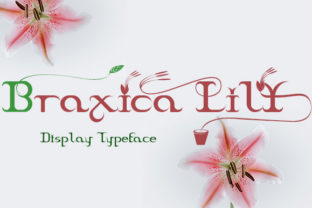
Braxica Lily stands apart in the landscape of display fonts—not because it shouts, but because it breathes. Designed with lilies as its central motif, this typeface translates botanical grace into typographic form: slender stems, soft curves, subtle asymmetry, and a quiet elegance that avoids ornamentation for its own sake. It’s not a decorative novelty—it’s a considered tool for designers and communicators who need to evoke tenderness, sincerity, or refined emotion without sacrificing clarity or professionalism.
What Makes Braxica Lily Distinctive
At its core, Braxica Lily is a serif display font built for impact at larger sizes—typically 36pt and up. Its letterforms incorporate gentle tapering strokes, delicate terminals, and carefully weighted contrast that mirrors the organic variation found in real lily petals. Unlike many floral-inspired fonts that lean into whimsy or script-like fluidity, Braxica Lily maintains structural integrity: upright proportions, consistent x-height, and balanced spacing make it legible even in tight headline layouts.
The design avoids cliché. There are no literal flower glyphs embedded in characters, nor does it rely on exaggerated swashes or excessive ligatures. Instead, its uniqueness emerges from restraint—how the lowercase a opens just slightly wider than expected, how the crossbar of the t lifts with quiet confidence, or how the descender of the y curves inward like a folded petal. These details accumulate into a voice that feels personal but never fragile.
Where Braxica Lily Performs Best
Braxica Lily excels where tone matters as much as information: editorial features, brand storytelling, wedding stationery, wellness branding, literary quotes, and boutique packaging. Its strength lies in context—not universality. For example, a small-batch skincare label might use Braxica Lily for product names (“Lumina Serum”, “Verdant Mist”) to reinforce natural authenticity and care. A university press could apply it to book cover titles in humanities or poetry collections, where emotional resonance supports intellectual weight.
It also works well in digital environments when used intentionally. On a blog post introducing a personal essay about grief and renewal, Braxica Lily’s title treatment adds gravitas without melodrama. Similarly, educators designing workshop handouts on empathy or mindfulness may find it aligns with thematic intent more effectively than neutral sans-serifs—without veering into sentimentality.
Practical Considerations for Real-World Use
Braxica Lily is not intended for body text. Its fine details begin to blur below 24pt, especially on lower-resolution screens or in print with absorbent paper. It includes standard Latin characters, basic punctuation, and common diacritics—but lacks extended language support (e.g., Cyrillic, Greek, or Vietnamese). Users working on multilingual projects should verify coverage before committing.
Kerning is well-executed across common pairs (AV, To, Wa), though manual adjustments may be needed for specific combinations involving uppercase F or L. The font ships in OpenType format with stylistic alternates—subtle variations for select letters that allow nuanced refinement, such as a more open e or a tapered r. These aren’t gimmicks; they’re functional options for tightening rhythm in short headlines.
Rendering consistency is strong across modern platforms. In browsers, it performs reliably with @font-face embedding and fallback stacks. On iOS and Android, it remains crisp at headline sizes, provided line height and letter spacing are adjusted to preserve airiness—tight tracking undermines its inherent lightness.
Audience Fit: Who Benefits Most
Freelance designers building brand identities for lifestyle, wellness, or creative services often face the challenge of balancing distinctiveness with credibility. Braxica Lily offers a middle ground: expressive enough to signal intention, grounded enough to avoid trend fatigue. Small business owners launching artisanal products—ceramics, botanical teas, handmade journals—find it complements tactile materials and muted color palettes without competing for attention.
Bloggers and content creators focused on narrative-driven formats—personal essays, memoir excerpts, reflective newsletters—use Braxica Lily to frame quotes or section headers in ways that deepen reader connection. It doesn’t distract; instead, it cues emotional receptivity. Educators preparing presentation decks for literature or art history courses report improved audience engagement when using Braxica Lily for key thematic statements—students recall the tone as much as the content.
That said, it’s less suited for fast-paced marketing campaigns, tech startups emphasizing innovation or disruption, or any context requiring immediate scannability at small sizes. Its value isn’t speed or neutrality—it’s resonance.
Quality and Long-Term Utility
Braxica Lily reflects careful craftsmanship. The outlines are clean, hinting is precise, and interpolation between weights (where available) maintains proportional logic. While currently offered in a single weight—regular—it’s optimized for optical size, meaning its metrics shift subtly depending on usage context (e.g., tighter spacing for large signage, looser for web banners).
Its longevity comes from intentionality, not ubiquity. Unlike fonts designed to be endlessly adaptable, Braxica Lily thrives within defined boundaries. That makes it reliable over time: it won’t feel dated in five years because it wasn’t chasing a moment. Designers who’ve used it across multiple client projects note that it rarely requires reworking—once paired thoughtfully with a supporting text face (a warm humanist sans like FF Meta or a structured serif like Adobe Garamond), it settles into place with minimal iteration.
Realistic Recommendations for Implementation
Start simple. Apply Braxica Lily to one high-impact element per layout—a hero headline, a pull quote, a chapter title. Avoid stacking it with other display fonts or heavy textures. Let it breathe: generous line height (1.4–1.6x), ample margin space, and restrained color contrast (e.g., charcoal on off-white rather than black on stark white) preserve its delicacy.
Test early and often—not just visually, but functionally. Print a sample at actual size. View it on a mobile device in ambient light. Ask a colleague unfamiliar with the project what feeling the headline conveys. If responses cluster around “calm,” “thoughtful,” or “intimate,” you’re aligned. If reactions skew toward “fussy” or “unclear,” revisit hierarchy or pairing choices.
Pairing matters critically. Avoid overly geometric sans-serifs (like Helvetica Neue) that clash tonally. Instead, choose text faces with modest stroke variation and open counters—fonts that support rather than contrast. For web use, define fallbacks that maintain vertical rhythm: font-family: "Braxica Lily", "Source Serif Pro", Georgia, serif; ensures graceful degradation.
Final Perspective
Braxica Lily isn’t a solution for every typographic need—and it shouldn’t be. Its purpose is narrow by design: to give voice to moments where beauty, tenderness, and quiet confidence matter more than efficiency or neutrality. When matched to the right message, medium, and audience, it performs with understated reliability. It won’t solve layout problems on its own, but it can elevate the emotional precision of your work—making abstract feelings legible, memorable, and humane. For professionals who understand that typography is never just about letters, but about how those letters make people feel, Braxica Lily earns its place—not as decoration, but as deliberate expression.