Cutout City: A Strategic Choice for Visual Communication and Creative Execution
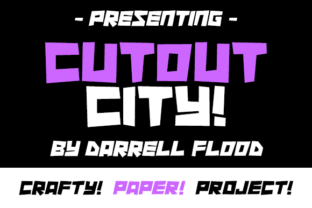
When selecting a typeface, most professionals focus on legibility, licensing, or aesthetic alignment—yet few consider how typography actively shapes perception, engagement, and execution. Cutout City stands apart not because it’s decorative, but because its angular, papercraft cut-out style introduces deliberate visual texture and tactile intentionality. It is not a background element—it’s a signal. Used thoughtfully, Cutout City supports clarity of purpose, reinforces thematic coherence, and invites interaction in ways that smoother, more neutral fonts cannot.
Why Cutout City Fits Strategic Creative Work
Cutout City excels where authenticity, hands-on energy, and approachable craftsmanship matter—not as a default headline font, but as a purpose-built tool. Its geometry echoes physical making: layered paper, sharp edges, intentional voids. That resonance matters for educators designing classroom posters, small business owners launching DIY kits, or marketers building campaigns around maker culture, sustainability, or tactile learning. Unlike fonts that recede into neutrality, Cutout City occupies space with quiet confidence—making it ideal when you need to communicate *how* something is made, not just *what* it is.
This isn’t about trend-chasing. It’s about matching visual language to operational reality. If your product, service, or content centers on assembly, customization, or participatory design—Cutout City becomes a subtle but consistent reinforcement of that ethos. It signals that process matters, that choices are visible, and that the user has agency in shaping the outcome.
Where Cutout City Adds Real Value (and Where It Doesn’t)
Strategic use starts with context. Cutout City delivers measurable value in specific scenarios:
- Product packaging and unboxing experiences for craft supplies, educational kits, or subscription boxes—its cut-out rhythm mirrors the physical act of peeling, folding, or assembling.
- Workshop materials and learning guides, especially those encouraging step-by-step creation—its angular clarity supports visual scanning without sacrificing warmth.
- Branded social assets for studios, makerspaces, or independent designers who position themselves as hands-on collaborators rather than distant service providers.
- Event signage and environmental graphics for pop-up markets, art fairs, or school exhibitions—where visual cohesion across print, digital, and physical touchpoints strengthens recognition.
Conversely, avoid Cutout City for long-form reading, data-heavy reports, legal disclaimers, or interfaces requiring rapid comprehension under time pressure. Its strength lies in emphasis—not endurance. Using it for body text or navigation labels dilutes its impact and risks undermining readability goals. The strategic decision isn’t whether it’s “nice,” but whether it serves the user’s next action.
Planning Your Use of Cutout City: Three Practical Filters
Before applying Cutout City, test it against these filters:
- Intent Alignment: Does this usage reflect a moment where you want the audience to pause, notice texture, or connect with materiality? If the goal is speed or neutrality, choose otherwise.
- Scale & Contrast: Cutout City performs best at medium to large sizes (24px and up on screen; 18pt+ in print) and benefits from generous spacing and high-contrast backgrounds. Avoid light gray text on white or tight letter-spacing—its cut-out character needs room to breathe.
- Complementary Pairing: Pair it deliberately—not decoratively. Strong sans-serifs like Inter, Montserrat, or Source Sans Pro provide grounded contrast. Avoid other display fonts with competing personalities. Let Cutout City anchor the visual hierarchy while supporting type handles utility and flow.
Risks of Unintentional Use—and How to Mitigate Them
The most common misstep isn’t poor aesthetics—it’s misaligned intent. When Cutout City appears without clear purpose, it can unintentionally signal informality where authority is expected (e.g., financial services branding), or distract from critical information (e.g., safety instructions). Worse, inconsistent application—using it once on a homepage banner and never again—creates visual fragmentation rather than brand cohesion.
To mitigate risk, treat Cutout City like a signature move: reserved for moments where its distinct qualities directly support a defined objective. Document *why* it’s used in each instance—not just “it looks fun.” For example: “Used in workshop title headers to reinforce the hands-on, build-together experience we promise participants.” That discipline prevents drift and builds internal alignment across teams.
Long-Term Branding Considerations
Typography contributes to brand memory over time—but only when applied with consistency and rationale. Cutout City can become a recognizable cue for audiences who associate it with creativity they can physically engage with. Think of it less as a “font” and more as a recurring visual motif—like a recurring paper-cut pattern in your collateral, or the repeated use of hand-drawn arrows in instructional diagrams.
That recognition compounds when paired with other tactile cues: textured paper stock, spot UV finishes, or even coordinated color palettes inspired by craft supplies (kraft brown, matte pastels, ink-black outlines). Over time, this ecosystem tells a coherent story: *We make things that invite participation. We value visible process. We design for doing—not just viewing.*
Decision-Making Guidance for Teams and Solo Practitioners
If you’re evaluating Cutout City for an upcoming project, ask yourself—or your team—these questions before committing:
- What behavior do we want the audience to take after seeing this? Does Cutout City support or interrupt that path?
- Does this usage appear alongside other tactile or process-oriented elements—or will it stand alone as an isolated stylistic choice?
- Do we have the production capacity to maintain its integrity across formats? (e.g., Will it render cleanly in email clients? Is there a fallback strategy for low-resolution displays?)
- Will future team members understand *why* it’s used here—or will it become legacy decoration without rationale?
For freelancers and small studios, Cutout City also serves as a quiet differentiator in proposals and presentations. Using it selectively in section headers or milestone markers subtly communicates fluency in experiential design—not just layout skills. That nuance builds credibility with clients who value intention over ornamentation.
Final Thought: Typography as Operational Clarity
Every design decision carries operational weight. Cutout City is no exception. Its angular precision doesn’t just look crafted—it invites crafting. When used with forethought, it aligns visual language with real-world actions: cutting, folding, arranging, teaching, building. That alignment reduces cognitive load for users and strengthens message retention for creators.
So don’t reach for Cutout City because it’s novel. Reach for it when your goal is to make the process visible—to honor the work behind the result, and to invite others into that same space of thoughtful making. In a landscape saturated with frictionless interfaces and seamless automation, Cutout City offers something rarer: honest texture, deliberate edges, and the quiet confidence of something built—by hand, with care, and on purpose.