Othelie: A Strategic Choice for Distinctive Visual Communication
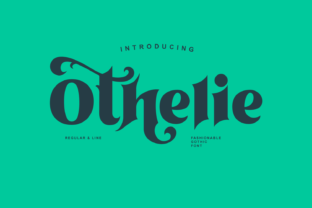
Othelie is not just another decorative font—it’s a deliberately crafted gothic typeface with strong architectural rhythm, subtle calligraphic warmth, and consistent stroke contrast. Designed for legibility at scale and expressive impact at point size, Othelie bridges aesthetic intention with functional reliability. For professionals who understand that typography shapes perception before a single word is read, Othelie offers more than visual flair: it delivers strategic alignment between voice, audience, and outcome.
Why Othelie Fits Purpose-Driven Design Decisions
Typography isn’t neutral. It signals tone, implies authority, and quietly influences how information is received and retained. Othelie’s gothic foundation—rooted in historical letterforms but refined for contemporary clarity—carries gravitas without stiffness. Its balanced x-height, open counters, and controlled terminal flares make it unusually versatile: equally effective on a laser-cut greeting card, a boutique product label, or a keynote slide headline. That versatility isn’t accidental—it reflects intentional design choices aimed at supporting real-world communication goals.
Consider this: when launching a premium skincare line targeting mindful consumers aged 30–45, the choice of typeface contributes directly to brand positioning. Using Othelie for packaging headers or website hero text reinforces craftsmanship, intentionality, and quiet confidence—qualities that resonate more deeply than generic sans-serifs or overused scripts. It doesn’t shout; it invites attention through presence and precision.
Strategic Use Cases Across Professional Contexts
Othelie shines where distinction matters—but only when applied with purpose. Below are grounded applications, not theoretical ideals:
- Branding & Identity Systems: Used selectively for logotypes, taglines, or chapter headings—not body copy—Othelie anchors a brand’s visual hierarchy with memorable weight. A freelance illustrator might use it for their portfolio site’s masthead, reinforcing a signature style without compromising readability in project descriptions.
- Print & Craft Projects: From hand-bound journals to limited-edition zines, Othelie scales beautifully in vector formats. Its clean outlines render crisply in vinyl cutting, laser engraving, and screen printing—reducing production errors and rework time.
- Digital Presentations & Marketing Assets: In slide decks or social media banners, Othelie works best at larger sizes (24pt and up) with ample line spacing. Paired with a neutral, highly legible sans-serif for body text—like Inter or Open Sans—it creates clear typographic contrast that guides attention without distraction.
- Educational & Editorial Materials: Educators designing workshop handouts or publishers laying out poetry chapbooks may use Othelie for section titles or pull quotes. Its rhythmic consistency supports scanning and retention—especially when paired with thoughtful whitespace and restrained color palettes.
Planning Your Use of Othelie: Three Practical Considerations
Adopting Othelie isn’t about swapping fonts—it’s about aligning typographic decisions with broader objectives. Before applying it, ask yourself:
- What is the primary action you want the viewer to take? If the goal is rapid comprehension (e.g., safety instructions or event logistics), Othelie is better suited to headlines than step-by-step text. Reserve it for moments where emphasis, mood, or identity reinforcement adds measurable value.
- Where will this appear—and how will it be consumed? On mobile screens, Othelie performs well in display roles but loses effectiveness below 18px. In print, test output at actual size: some gothic fonts suffer from ink spread or rasterization issues on low-DPI printers. Always proof in context—not just in design software.
- Does it coexist well with your existing type system? Othelie pairs most effectively with humanist sans-serifs or low-contrast serifs. Avoid pairing it with other high-contrast gothics or ornamental scripts—visual competition dilutes impact. A simple test: set a sentence in Othelie next to your body font. Does the relationship feel supportive—or strained?
Risks of Misaligned Implementation
Using Othelie without grounding in goals introduces tangible risks—not just aesthetic ones. Overuse flattens its impact: when every heading, button, and footer uses Othelie, it ceases to signal importance and instead signals indecision. Worse, applying it to long-form content undermines accessibility and readability, potentially alienating users who rely on screen readers or have visual processing differences.
There’s also a subtler risk: misalignment with audience expectations. A fintech startup targeting enterprise clients may find Othelie’s gothic character at odds with perceptions of stability and transparency—unless carefully contextualized (e.g., used only in brand storytelling assets, not compliance documents). The font itself isn’t “wrong”; the mismatch between typographic intent and audience context is.
How to Use Othelie Intentionally—Not Decoratively
Intentional use begins with restraint and expands through repetition with variation. Start small: apply Othelie to one high-impact element—a logo lockup, a series title, or a recurring CTA banner—and measure response. Track engagement metrics if possible: does a redesigned email header using Othelie increase open rates? Does a product page with Othelie-based section dividers improve scroll depth?
Build consistency—not uniformity. Use Othelie at three defined weights (Light, Regular, Bold) across your system, never mixing arbitrary variants. Define exact sizing rules: e.g., “Othelie Bold at 36px for H1, 28px for H2, 20px for subheads—always with 1.3 line-height.” These constraints free creative energy elsewhere while strengthening recognition.
Also consider timing. Launch Othelie alongside a broader brand refinement—not as an isolated update. When a small business repositions from “general craft supplier” to “curated tools for intentional makers,” introducing Othelie across new packaging, website headers, and workshop materials reinforces that shift holistically. The font becomes part of the narrative—not just its decoration.
Long-Term Value Beyond Aesthetics
The lasting value of Othelie lies in its durability as a strategic asset—not its novelty. Unlike trend-driven display fonts that fade within 12–18 months, Othelie’s balance of heritage and modernity gives it staying power. Design systems built around it age gracefully because they prioritize function alongside form.
For freelancers and small teams, that durability translates to efficiency: once established, Othelie-based templates require fewer revisions, faster client approvals, and clearer internal alignment. For educators and creators, it supports pedagogical clarity—using typographic hierarchy to separate concepts, examples, and reflections without relying solely on color or layout.
Most importantly, choosing Othelie thoughtfully signals a deeper commitment: to making decisions rooted in observation, testing, and outcomes—not assumptions or aesthetics alone. That discipline compounds over time, influencing everything from client briefs to product roadmaps.
Final Guidance: Let Othelie Serve Your Goals—Not the Other Way Around
Othelie earns its place when it answers a specific need—not when it fills a stylistic gap. Before downloading or licensing it, clarify the problem you’re solving: Is it about strengthening brand recall? Improving visual hierarchy in printed materials? Differentiating a product line in a saturated market? Each of those calls for different implementation tactics—and different thresholds for success.
Test early, test often, and always tie results back to objectives. A/B test two versions of a landing page—one with Othelie for the headline, one without—and measure time-on-page, bounce rate, and conversion. If the difference is negligible, revisit your hypothesis. Maybe the issue isn’t the font—it’s the message, the offer, or the user journey.
In the end, Othelie is a tool—not a solution. Its power emerges only when wielded with clarity, consistency, and care. Used well, it supports better decisions, sharper communication, and more resonant outcomes. Used without strategy, it’s just another layer of noise. Choose deliberately. Apply intentionally. Measure honestly.