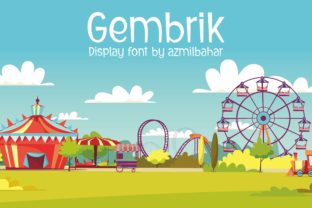
Gembrik: A Strategic Choice for Joyful, Cartoon-Inspired Communication
When your project calls for unmistakable warmth, playful energy, and immediate visual friendliness—especially in comic-themed crafts, children’s publishing, educational materials, or brand expressions rooted in lighthearted authenticity—Gembrik stands apart. It’s not just another display font. It’s a deliberate stylistic tool: a rounded, bouncy, cartoonish typeface engineered to evoke joy without sacrificing legibility at scale. Its generous x-height, soft curves, and slightly exaggerated letterforms create rhythm and approachability—qualities that matter deeply when you’re shaping perception, guiding attention, or reinforcing emotional alignment with an audience.
Why Gembrik Fits Into Intentional Design Strategy
Strategic typography isn’t about aesthetics alone—it’s about reducing cognitive load while amplifying intent. Gembrik excels where clarity meets character: on book covers for middle-grade graphic novels, packaging for eco-friendly toy lines, workshop signage for creative educators, or social media banners for indie craft studios. Its consistent stroke contrast and open counters ensure it remains readable even in constrained spaces—like mobile thumbnails or printed stickers—while its personality signals values: inclusivity, playfulness, and human-centered thinking.
That said, Gembrik is not a universal solution. Its strength lies in specificity. Using it for body text, legal disclaimers, or data-dense dashboards undermines both function and credibility. Its strategic value emerges only when matched to goals that benefit from expressive tone—such as lowering barriers to engagement, reinforcing brand voice in visual storytelling, or making learning materials feel less intimidating.
Where Gembrik Delivers Measurable Value
Consider these grounded use cases where Gembrik supports real-world outcomes:
- Educators designing classroom posters or digital story prompts: Gembrik helps signal “this is safe to explore”—reducing hesitation in early readers or neurodiverse learners who respond well to visual predictability and emotional warmth.
- Small business owners launching handmade greeting cards or sticker sets: The font reinforces artisanal authenticity and hand-drawn charm, helping products stand out in saturated marketplaces like Etsy or Instagram Shop—without requiring custom illustration for every headline.
- Freelance designers building brand identities for family-focused startups (e.g., meal kits for kids, bilingual literacy apps): Gembrik can serve as a primary display anchor—paired with a neutral sans-serif for body copy—to communicate care, accessibility, and developmental awareness.
- Publishers developing chapter headings or section dividers in illustrated nonfiction for ages 8–12: Here, Gembrik acts as a subtle narrative cue—guiding young readers through structure while preserving momentum and curiosity.
Notice the pattern: Gembrik works best when it supports a defined user need—not when it’s applied decoratively. That distinction separates tactical execution from strategic design.
Planning Your Use of Gembrik: Three Practical Filters
Before embedding Gembrik, apply these filters to avoid misalignment:
- Goal Filter: Does your objective involve evoking delight, signaling approachability, or softening formality? If your aim is authority, urgency, or technical precision, choose differently. Gembrik invites connection—not command.
- Context Filter: Where will this appear? Print size matters: at 14pt on a postcard, Gembrik sings; at 9pt in a PDF footnote, it blurs. Likewise, background contrast is non-negotiable—light gray text on white won’t cut it, even with Gembrik’s friendly shape.
- Consistency Filter: How many other expressive fonts live in your system? Overloading with multiple high-personality typefaces fragments recognition. Reserve Gembrik for one clear role—headline, logo lockup, or CTA button—and pair it deliberately (e.g., with Inter, Open Sans, or Lato) to ground contrast in purpose, not whimsy.
These aren’t restrictions—they’re guardrails that protect your message from getting lost in style.
Risks of Using Gembrik Without Clarity
Without intention, Gembrik can unintentionally weaken credibility. Imagine a financial advisor using it in a retirement planning brochure: the mismatch between tone and expectation creates friction—not trust. Similarly, overusing Gembrik across all touchpoints dilutes its impact. When everything feels joyful, nothing feels special.
Another subtle risk: assuming personality replaces substance. A beautifully rendered Gembrik-based workshop flyer won’t compensate for unclear learning outcomes or poor facilitation. The font opens the door—but what’s inside determines whether people stay.
This is why Gembrik demands context-aware deployment. It’s most powerful when it echoes decisions already made about audience, message hierarchy, and emotional resonance—not when it substitutes for them.
Pairing and Production Considerations
Effective pairing starts with contrast—not contradiction. Gembrik thrives beside typefaces with clean geometry, modest stroke variation, and strong vertical rhythm. Avoid overly decorative companions (e.g., script fonts with flourishes) or monospaced fonts lacking warmth—both compete rather than complement.
In production, test early and often:
- Render Gembrik at intended sizes across devices—especially iOS Safari and Android Chrome, where font hinting can affect spacing.
- Check line height: its tall x-height often benefits from +5–10% leading in display settings to preserve airiness.
- Verify licensing for your use case—some versions restrict web embedding or commercial redistribution. When in doubt, source directly from reputable foundries or platforms with clear EULAs.
Also consider fallback behavior. If Gembrik fails to load, does your CSS specify a visually harmonious substitute (e.g., "Comic Neue", "Chewy", cursive)—or does it default to Times New Roman, breaking tone entirely?
Long-Term Brand Alignment With Gembrik
Brands evolve. So should typographic choices. If you adopt Gembrik today, ask: does it scale with your growth? A children’s podcast might launch with Gembrik in its logo and episode titles—then gradually introduce more restrained variants (e.g., bold weights only, or limited to seasonal campaigns) as its audience matures or content diversifies.
Document your rationale. Note why Gembrik was chosen—not just “it looks fun,” but “it reflects our commitment to reducing anxiety around creative expression for beginners.” That clarity becomes invaluable during team onboarding, redesign cycles, or stakeholder reviews.
And remember: fonts don’t build brands alone. Gembrik gains meaning through repetition, context, and consistency—not isolated brilliance. Its longevity depends on how thoughtfully it’s woven into your broader communication ecosystem.
Making the Decision: Is Gembrik Right For This Project?
Ask yourself three questions before committing:
- What emotion must this element convey—and is joy, warmth, or lightness essential to the outcome? If neutrality or gravitas serves the goal better, skip Gembrik.
- Will this usage reinforce—or contradict—existing brand signals? A tech startup pivoting toward playful edtech might test Gembrik in beta campaign assets before full rollout.
- Do we have the capacity to use it consistently and correctly? If team members lack access to the font file, training on sizing guidelines, or approval workflows for expressive type, delay adoption until systems catch up.
There’s no penalty for waiting. There is a cost to deploying Gembrik without alignment—confusion, rework, diluted recognition.
Used with discipline, Gembrik does more than decorate. It lowers thresholds. It invites participation. It quietly affirms that creativity doesn’t require perfection to be valuable. That’s not just design thinking—that’s human-centered strategy in action.