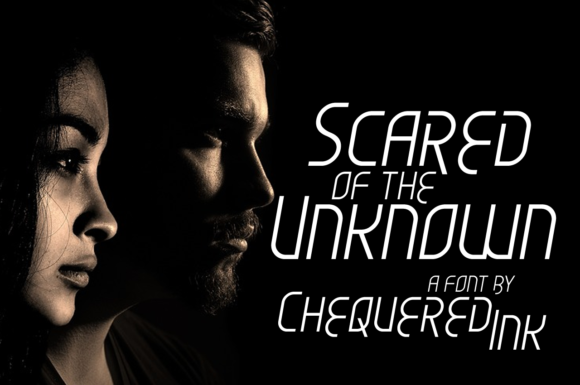
Scared of the Unknown: A Bold, Expressive Display Font for Meaningful Visual Communication
Feeling uncertain about how to make your posters, logos, or branding materials stand out—without sacrificing authenticity or impact? You’re not alone. Many designers, marketers, and small business owners face a quiet but persistent challenge: choosing a typeface that commands attention *and* reflects intention—not just style, but substance. That’s where Scared of the Unknown, a distinctive display font from Chequered Ink, steps in—not as a decorative afterthought, but as a thoughtful tool for visual clarity and emotional resonance.
At its core, Scared of the Unknown is more than just a set of letters. It’s a carefully crafted display font designed for high-visibility applications: exhibition posters, book covers, event branding, logo lockups, and digital banners where legibility meets personality. Its name hints at something deeper—a willingness to embrace ambiguity, curiosity, and creative risk—and that spirit translates directly into its expressive, slightly irregular, hand-influenced letterforms. Unlike rigid geometric sans-serifs or overly ornate scripts, Scared of the Unknown balances confidence with approachability, structure with subtle humanity.
Why This Font Answers Real Design Challenges
Designers and communicators often juggle competing priorities: grabbing attention in under three seconds, staying true to brand voice, ensuring readability across sizes and screens, and avoiding visual fatigue. Generic fonts—especially overused system or free web fonts—can unintentionally dilute messaging. When every café, startup, and wellness coach uses the same minimalist sans-serif, differentiation becomes difficult. That’s where purpose-built display fonts like Scared of the Unknown offer practical relief.
Consider these common situations:
- You’re designing a poster for a thought-provoking talk series—one focused on innovation, psychology, or social change. A sterile, ultra-thin font might feel detached; a heavy slab serif could feel authoritarian. Scared of the Unknown offers warmth and weight without heaviness, inviting engagement rather than demanding it.
- You’re developing a logo for a boutique therapy practice or mindfulness app. You need something memorable but not gimmicky—professional yet compassionate. Its gentle irregularities (like slight variations in stroke width and baseline rhythm) suggest empathy and presence, not perfectionism.
- You’re building a limited-edition product label or zine cover and want typography that feels intentional, tactile, and human-made—not algorithmically optimized. The font’s organic texture works beautifully in print, especially when paired with thoughtful paper stock or spot varnish.
How Scared of the Unknown Supports Practical Outcomes
The value of Scared of the Unknown lies not in novelty alone—but in how reliably it helps users achieve specific, measurable results:
- Stronger first impressions: In environments saturated with visual noise—social feeds, crowded trade shows, or busy retail shelves—this font’s confident x-height and open counters improve scannability at distance and small sizes.
- Enhanced message alignment: Because its design carries subtle connotations of openness and inquiry, it naturally supports themes like growth, learning, transition, or self-discovery—making it ideal for education, coaching, publishing, or nonprofit work.
- Streamlined creative decisions: Instead of cycling through dozens of options or over-customizing a base font, designers report faster iteration when starting with a cohesive, personality-driven typeface like this one. Its built-in character reduces the need for excessive kerning tweaks or stylistic overrides.
Practical Tips for Using Scared of the Unknown Well
Like any expressive tool, Scared of the Unknown shines brightest when used intentionally—not everywhere, but where it matters most. Here’s how thoughtful users apply it:
- Reserve it for display roles: Use it for headlines, logos, pull quotes, or short statements—not body text. Its generous spacing and moderate contrast are optimized for impact, not extended reading.
- Pair it wisely: Contrast is key. Pair it with a clean, neutral sans-serif (like Inter, Lato, or even Helvetica Neue) for supporting text. Avoid other display or script fonts that compete for attention.
- Test at real-world sizes: Preview your design on actual devices or printed mockups. While it scales well, extremely small applications (e.g., 10pt captions) may lose nuance—reserve it for 24pt and up in most contexts.
- Consider licensing needs: Chequered Ink offers clear, ethical licensing—including web, desktop, and app use. If you’re using it commercially (e.g., in client work or product packaging), verify the appropriate license tier. Their straightforward terms support sustainable design practice.
Different Users, Different Approaches
How you engage with Scared of the Unknown depends on your role—and goals:
- Freelance designers appreciate its versatility across industries and its ability to elevate mid-tier projects without overcomplicating files or workflows.
- In-house marketing teams find it useful for unifying campaign visuals—especially when launching initiatives tied to change, learning, or community building.
- Self-publishing authors and indie creators rely on it to convey tone quickly on covers and promotional assets, helping readers intuit genre and mood before a single word is read.
- Educators and workshop facilitators use it in handouts and slides to reinforce themes of curiosity and reflection—its visual “imperfections” subtly model the idea that exploration doesn’t require certainty.
Importantly, Scared of the Unknown isn’t about evoking fear—it’s about honoring the productive tension that comes with stepping into new territory. That makes it uniquely suited for audiences who value authenticity over polish, meaning over mimicry, and clarity over clutter.
If you’ve been hesitant to commit to a bold typographic choice—or frustrated by fonts that look great in previews but fall flat in context—Scared of the Unknown invites a different approach: one grounded in craft, aligned with purpose, and open to possibility. It won’t solve every design problem, but it reliably solves several of the most common ones—especially when what you really need is a voice that feels both certain and kind.
Ready to explore further? Visit Chequered Ink’s site to preview Scared of the Unknown in action, review licensing options, and see real-world examples that demonstrate its range—from serene to spirited, always sincere.