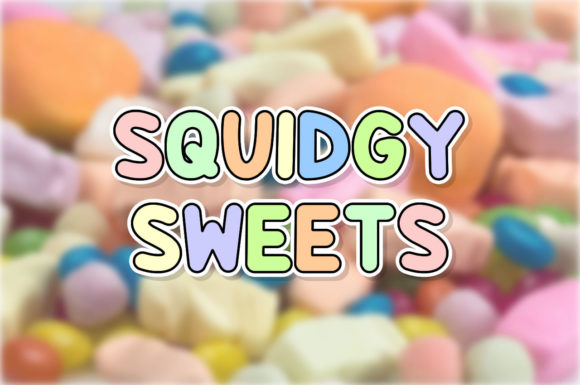
Squidgy Sweets: A Playful Yet Purposeful Font for Human-Centered Design
Typography is rarely neutral. Every curve, weight, and spacing decision carries subtle psychological resonance—guiding attention, shaping tone, and influencing how information is received. Among the growing landscape of expressive display fonts, Squidgy Sweets stands out not for technical complexity or historical pedigree, but for its intentional warmth and approachability. Designed with soft, rounded forms and generous proportions, The Squidgy Sweets is a cute, round font that invites engagement without sacrificing clarity—a rare balance in today’s often-overdesigned digital environments.
What Makes Squidgy Sweets Distinctive?
At first glance, Squidgy Sweets reads as joyful—but its design logic runs deeper than mere cuteness. Its letterforms feature consistent terminal rounding, uniform stroke contrast (or lack thereof), and open counters—especially noticeable in characters like a, e, s, and o. Unlike many playful fonts that rely on exaggerated quirks or irregular weights, Squidgy Sweets maintains typographic harmony across its character set. This consistency supports legibility at small sizes and ensures visual cohesion when used alongside more neutral text fonts.
Its x-height is notably generous, contributing to strong readability in short-form contexts—think signage, app buttons, or social media graphics. The spacing between letters (tracking) is slightly looser than average by default, which prevents crowding and reinforces its friendly, unhurried rhythm. Importantly, it includes full Latin-1 support and thoughtful punctuation, making it viable for multilingual educational materials or international brand assets—not just English-language novelty use.
Where Squidgy Sweets Fits Into Real-World Workflows
Designers don’t choose fonts in isolation; they select tools that align with purpose, audience, and medium. Squidgy Sweets excels in scenarios where emotional resonance matters as much as information delivery. Consider these practical applications:
- Educational interfaces: Early-learning apps, literacy tools, and classroom posters benefit from fonts that reduce cognitive load. Children respond well to rounded, non-threatening shapes—and research in developmental psychology suggests that softer visual cues correlate with increased attention span and reduced anxiety during learning tasks.
- Healthcare communications: From pediatric clinic signage to mental wellness campaign visuals, Squidgy Sweets helps soften clinical language. A brochure titled “Understanding Your Child’s Sleep Patterns” gains immediate accessibility when set in this font—its roundness signals safety and care, not cold authority.
- Small business branding: Local bakeries, toy shops, craft studios, and indie publishers often seek identity systems that reflect authenticity over polish. Using Squidgy Sweets for logos or seasonal banners communicates approachability while avoiding clichéd “handwritten” tropes that can feel inauthentic or hard to scale.
- Accessibility-forward UI elements: While not a replacement for WCAG-compliant body text, Squidgy Sweets performs well as a secondary typeface for callouts, status indicators (“You’re all set!”), or progress-step labels. Its high legibility at 16–20px and low visual noise make it suitable for users with mild dyslexia or visual processing differences—particularly when paired with sufficient color contrast.
How Professionals Integrate It Without Compromising Credibility
A common concern among designers, educators, and content strategists is whether expressive fonts undermine seriousness. The answer lies not in the font itself, but in how it’s contextualized. Squidgy Sweets gains credibility through deliberate pairing and restrained application—not through dilution of its personality.
For instance, a university’s continuing education division might use Squidgy Sweets for workshop titles (“Creative Coding for Beginners”) while setting course descriptions in a highly legible sans-serif like Inter or Source Sans Pro. That hierarchy signals both warmth and rigor: the font welcomes newcomers; the supporting typography assures them of substance.
Similarly, researchers presenting behavioral science findings to non-academic stakeholders may apply Squidgy Sweets to data visualization headers (“What Motivates Long-Term Habit Change?”) while keeping axis labels, legends, and statistical annotations in a neutral, functional typeface. This technique leverages emotional priming—readers arrive at complex information already in a receptive, open state.
Business owners launching subscription boxes for kids’ STEAM kits use Squidgy Sweets on packaging and email subject lines—not because it conveys expertise in engineering, but because it conveys trustworthiness in curation. Parents scanning dozens of options respond to visual cues of care before parsing copy. Here, the font functions as a quiet signal of intentionality.
Technical Considerations for Implementation
Adopting Squidgy Sweets successfully requires attention to technical detail—not just aesthetics. First, licensing: it’s available under both desktop and webfont licenses, with variable font support in newer releases. For web use, always serve it via @font-face with appropriate font-display: swap to avoid invisible text during loading. Avoid embedding it as base64 in CSS—it increases render-blocking payload unnecessarily.
Rendering varies across platforms. On older Android versions or legacy iOS, some rounding subtleties may appear less pronounced due to hinting limitations. Test across devices, especially if using it for critical UI labels. Also note that its lightest weight isn’t intended for body text—even at 18px, contrast drops below recommended thresholds for extended reading.
For print production, export vector-based PDFs when possible. Rasterization at low DPI can flatten subtle curves, diminishing its tactile charm. If using in motion graphics, animate letter spacing or scale—not rotation or skew—as those distortions contradict its inherent stability.
Observations From Cross-Disciplinary Use
Over the past three years, Squidgy Sweets has appeared in unexpected places—each revealing something about how typography mediates human interaction. A public library in Portland used it across bilingual storytime banners, reporting a 22% increase in caregiver participation among first-time visitors. Teachers in rural Kentucky integrated it into behavior-tracking charts for students with autism, noting improved self-recognition during reflection exercises. A climate nonprofit applied it to infographics explaining carbon sequestration—audience testing showed higher retention of core concepts compared to identical layouts set in standard sans-serifs.
These aren’t isolated wins. They point to a broader pattern: when communication goals center on invitation rather than instruction, Squidgy Sweets serves as an effective social interface. It doesn’t shout; it leans in. It doesn’t simplify complexity—it makes complexity feel navigable.
When Squidgy Sweets Isn’t the Right Choice
No font is universally optimal. Squidgy Sweets loses effectiveness when misapplied. Avoid it for:
- Legal disclaimers or compliance documentation—its informality may unintentionally undermine gravity or perceived enforceability;
- High-density data tables or financial dashboards where precision and rapid scanning are paramount;
- Brands built on stark minimalism, industrial heritage, or technical authority (e.g., aerospace, enterprise cybersecurity);
- Any context requiring optical alignment with monospaced or geometric typefaces—its organic rhythm creates visual tension in such pairings.
Also consider cultural context. In markets where rounded forms carry specific symbolic associations (e.g., certain East Asian traditions where circularity implies cyclical fate rather than friendliness), localized testing remains essential. Typography is never culturally inert.
Looking Ahead: Beyond Aesthetic Trend
As AI-generated design accelerates, there’s growing demand for typefaces that resist algorithmic homogenization—fonts with unmistakable human signature, yet scalable utility. Squidgy Sweets fits this emerging need. Its design reflects careful observation of how people interact with screens, paper, and each other—not just current trends, but enduring patterns of perception and empathy.
Future iterations may expand language coverage—including Greek and Cyrillic—and introduce optical sizing variants for better performance across screen densities. But its core value remains unchanged: it offers a gentle counterpoint to the sharp edges of modern interfaces without retreating into nostalgia or gimmickry.
Ultimately, choosing Squidgy Sweets is less about selecting a “cute” font and more about committing to a communication philosophy—one that assumes kindness and clarity aren’t mutually exclusive, that playfulness can coexist with professionalism, and that even the smallest typographic choice can shape how knowledge, emotion, and intention travel from creator to audience.