Bad Hunters: A Bold Brush Font for Impact
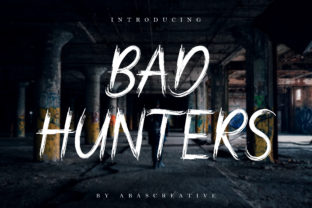
Bad Hunters isn’t just another decorative typeface—it’s a visual spark plug. Designed with raw, street-smart energy, it captures the urgency and attitude of hand-painted signage, graffiti tags, and fast-paced urban expression. If you’ve ever needed a font that shouts without shouting *at* people—just commands attention with confidence—Bad Hunters fits that role perfectly.
What Makes Bad Hunters Stand Out?
At its core, Bad Hunters is a brush-style display font built for immediacy. Its strokes are quick, decisive, and slightly irregular—like ink dragged across paper in one confident motion. Sharp terminals, dynamic contrast, and subtle texture give it authenticity, not polish. It doesn’t try to be neutral or invisible. Instead, it leans into personality: bold, unfiltered, and full of movement.
Unlike many script or brush fonts that soften edges for readability at small sizes, Bad Hunters embraces its roughness. That’s intentional. It’s meant for moments where tone matters as much as text—where “limited edition,” “drop live now,” or “this changes everything” needs to land with physical presence.
Who Benefits Most From Using Bad Hunters?
Designers, marketers, and small business owners often reach for Bad Hunters when they want to signal authenticity, energy, or rebellion—not chaos. A coffee shop launching a new cold brew line might use it on a chalkboard-style poster. A fitness coach could feature it in an Instagram story announcing a 30-day challenge. An indie band might build their entire album artwork around its rhythm and grit.
Beginners love it because it’s intuitive: no complex layering or effects needed. Drop it into Canva, Figma, or Adobe Express, pair it with a clean sans-serif for body text, and you’ve got instant visual hierarchy. Professionals appreciate how quickly it communicates mood—cutting down revision rounds when clients need “more edge” or “less corporate.”
Real-World Uses That Work Well
- Event posters and flyers: A local music festival uses Bad Hunters for headliner names—immediately signaling high energy and community-driven vibes.
- Social media graphics: A freelance photographer overlays “RAW • REAL • READY” in Bad Hunters over a moody street portrait—reinforcing their brand voice before viewers even read the caption.
- Product packaging: A hot sauce brand prints “FIRE STARTER” across the front label—leveraging the font’s sharp angles and thick-thin contrast to mirror heat and intensity.
- Educational workshop banners: A design educator uses Bad Hunters for “SKETCH FAST, THINK FASTER” on a classroom banner—encouraging action over overthinking.
It’s less effective for long paragraphs, legal disclaimers, or accessibility-critical interfaces—but that’s not its job. Think of it like a well-chosen exclamation point: powerful in context, exhausting in excess.
Pairing Bad Hunters Thoughtfully
Because Bad Hunters carries so much character, pairing matters more than usual. Try it with grounded, no-nonsense typefaces: Montserrat, Inter, or even classic Georgia. Avoid other high-contrast scripts or overly ornate fonts—they’ll compete instead of complement.
Spacing also plays a key role. Letterspacing (tracking) slightly tighter than default helps maintain cohesion, especially at larger sizes. And don’t shrink it too far: it shines best at 36pt and up in print, or 48px+ on screen.
Things to Keep in Mind Before You Use It
First, consider your audience’s expectations. While Bad Hunters feels fresh and modern to many, some conservative industries—like financial planning or healthcare compliance—may find it too informal for primary branding. That doesn’t mean it can’t appear *somewhere* (a campaign headline, a newsletter teaser), but know when it supports—and when it distracts from—your message.
Second, check licensing. Bad Hunters is typically offered under desktop, web, and app licenses—some free for personal use, others requiring purchase for commercial projects. Always verify permissions before launching a client site or printing 500 merch items.
Third, test legibility across devices. On mobile, large letterforms with tight spacing can blur if not optimized. Preview on actual phones—not just browser simulators—to ensure impact stays intact.
Why It Fits So Many Creative Goals
Bad Hunters works because it answers a quiet but common need: how do I make something feel human, urgent, and memorable—without spending hours custom-drawing it? It bridges the gap between DIY charm and professional polish. You get the spontaneity of hand-lettering, backed by consistent kerning, OpenType features (like stylistic alternates), and multi-weight options in many versions.
For educators, it’s a tool to demonstrate typographic voice—how shape, weight, and rhythm influence perception. For entrepreneurs, it’s a shortcut to standing out in crowded feeds. For hobbyists, it’s permission to play boldly without needing calligraphy skills.
A Few Practical Tips for First-Time Users
- Start simple: Use it for one line only—a title, a tagline, a button label. See how it changes the tone of your layout.
- Try reversing it: White text on dark background often heightens its contrast and drama.
- Don’t over-accessorize: Skip shadows, glows, or heavy outlines. Let the font’s natural texture speak.
- Print a test sheet: Sometimes what looks energetic on screen reads as “busy” on paper—especially on textured stock.
- Ask yourself: Does this choice reflect what the content *does*, not just what it says? If your message is about speed, craft, or attitude—Bad Hunters likely fits.
Ultimately, Bad Hunters isn’t about being loud for loudness’ sake. It’s about matching form to function—with honesty, energy, and a little swagger. When used with intention, it doesn’t just say something. It makes people pause, feel something, and remember it.