Mocker: A Bold Brush Font with Real Impact
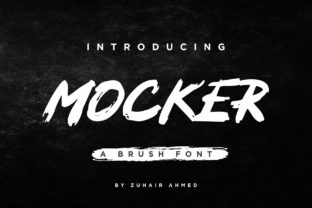
If you’ve ever stared at a design and thought, “It’s missing weight—something that lands,” then Mocker might be the quiet solution you’ve overlooked. It’s not another delicate script or minimalist sans serif. Mocker is a premium brush font built for presence: thick, confident strokes, subtle texture, and intentional irregularity that feels hand-painted—not digitized. Each letter carries energy without shouting. That balance—boldness with authenticity—is why designers, small business owners, and content creators reach for Mocker when they need clarity *and* character in one typeface.
What Makes Mocker Stand Out Visually
Mocker belongs to the brush script family—but it’s not the kind you’d use for wedding invites or café chalkboards. Its letters have strong contrast between thick downstrokes and fine hairlines, giving it rhythm and visual punch. The terminals taper naturally, and slight variations in stroke width mimic real brush pressure—not random wobble, but controlled human gesture. There’s no excessive flourish or decorative swash; instead, Mocker leans into clean, modern typography with a tactile edge. It reads as contemporary, not retro, and feels grounded—not playful, not stern, but assured.
Unlike many script fonts that sacrifice legibility at smaller sizes, Mocker holds up surprisingly well from 24pt down to 16pt in print—and even on high-res mobile screens—when used sparingly and with enough contrast. That’s rare for a display font. It doesn’t try to be everything. It knows its role: commanding attention where it matters most.
Where Mocker Earns Its Place in Real Projects
You’ll see Mocker working hardest where personality meets purpose. Think logo design for a craft brewery, an artisanal skincare line, or a boutique fitness studio—brands that want warmth and strength in equal measure. In editorial design, it shines as a masthead or section header in a lifestyle magazine, adding distinction without competing with body text. On packaging, especially for food or handmade goods, Mocker gives shelf presence while still feeling approachable.
For digital use, it works well in social media graphics (Instagram carousels, Pinterest banners), email headers, and hero sections of small business websites—particularly when paired with a neutral sans serif like Inter or Montserrat for supporting text. It’s less suited for long-form web copy or UI labels, and that’s by design. Mocker isn’t meant to whisper. It’s meant to open the conversation.
Bloggers and content creators use it for quote overlays, podcast cover art, and workshop branding—anywhere they want their voice to feel both personal and polished. Crafters and hobbyists apply it to printable planners or SVG cut files because its bold structure translates cleanly to vinyl and paper cutting tools.
How Mocker Shapes Perception—and Why That Matters
Typeface choice quietly shapes how people read your brand before they read a single word. Mocker signals confidence without coldness, creativity without chaos. When used consistently across touchpoints—say, on a business card, website banner, and Instagram highlight icon—it reinforces recognition. That consistency builds trust, especially for solopreneurs and micro-brands without large marketing budgets.
It also supports visual hierarchy effortlessly. Drop Mocker in as a headline over clean body text, and the eye moves exactly where you intend. No extra styling needed. That saves time and reduces decision fatigue during design sprints. And because it’s inherently distinctive—not generic or overused—it helps avoid visual blending in crowded feeds or marketplaces.
Importantly, Mocker avoids the “trendy” trap. It doesn’t rely on current fads like exaggerated x-heights or extreme variable axes. Its appeal is rooted in craftsmanship, not novelty—so it ages well. A logo designed with Mocker today won’t look dated in three years.
Practical Tips Before You Use It
Start by checking what styles are included. Most Mocker licenses offer at least Regular and Bold weights—some include a matching sans serif companion. Don’t assume it comes with italics or condensed variants unless stated. If your project needs flexibility (e.g., subtitles or captions), verify whether lighter or narrower options exist.
Test pairings early. Mocker pairs best with typefaces that provide calm counterpoint: geometric sans serifs (like Poppins or Work Sans), low-contrast humanist sans serifs (like Lato), or even restrained serifs (like Merriweather) for editorial depth. Avoid other scripts or overly decorative fonts—they’ll compete, not complement.
Readability hinges on spacing and context. Use generous letter-spacing (50–100 units in design apps) for headlines. For short phrases—“Handcrafted Daily” or “Bold Ideas Start Here”—it sings. For longer lines, test at actual size and distance. If it blurs or loses shape, scale back or switch to a supporting typeface.
Licensing is straightforward but essential. Mocker is a commercial font, meaning free download sites often host unlicensed copies. Always purchase directly from the foundry or authorized resellers like Creative Market or MyFonts. A standard license covers desktop use, web embedding (with CSS @font-face), and basic app integration. If you’re building a SaaS product or selling templates with Mocker baked in, check extended licensing terms—most require separate permissions.
A Few Real-World Observations
We’ve seen Mocker elevate a local pottery studio’s Instagram posts—replacing generic fonts with something that mirrored the physicality of clay and glaze. In another case, a financial coach used it for her workshop title slides: the boldness softened the perceived rigidity of finance topics, making concepts feel more accessible.
One publisher told us they tested Mocker against three alternatives for a book series subtitle. Readers consistently rated the Mocker version as “more memorable” and “more trustworthy”—not because it looked expensive, but because it felt intentional and human-made.
That’s the quiet power of Mocker: it doesn’t ask to be admired. It asks to be understood—and then remembered.