Beat the Ordinary: A Playful, Bold Display Font
If you’ve ever stared at a design and thought, “It’s clean—but it’s missing something,” Beat the Ordinary might be exactly what you need. It’s not a font for body text or spreadsheets. It’s a display typeface built for impact—playful enough to spark joy, bold enough to command attention, and rich with expressive swashes that give every letter personality.
What Makes Beat the Ordinary Stand Out?
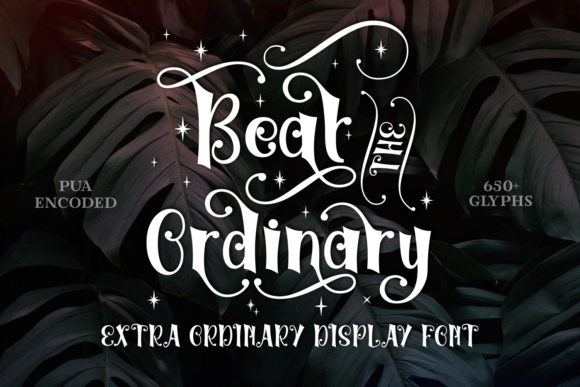
At its core, Beat the Ordinary is a hand-crafted display font designed to break visual routines. Its uppercase letters feature dramatic flourishes—curving terminals, looping ascenders, and confident strokes that flow like ink drawn with intention. Lowercase characters keep rhythm and readability while still carrying that same spirited energy. Unlike rigid geometric fonts or overly ornate scripts, it strikes a rare balance: structured enough for clarity, expressive enough to feel human.
The swashes aren’t just decorative extras—they’re functional accents. Turn on OpenType features in compatible software (like Adobe Illustrator or Affinity Designer), and you’ll unlock alternate glyphs, ligatures, and contextual swashes that respond naturally to letter combinations. That means “Hello” doesn’t look like two static words—it looks like a small, joyful performance.
Who Benefits Most From This Font?
Creators who want their work to feel memorable—not generic—will immediately connect with Beat the Ordinary. Think of it as your visual voice amplifier: it helps your message land with warmth and confidence, without sounding forced or trendy.
Small business owners often struggle to stand out in crowded digital spaces. A café launching a new seasonal menu? A handmade jewelry brand refreshing its Instagram stories? An educator designing a workshop poster? In each case, Beat the Ordinary adds distinction without complexity. It says, “We care about how this feels—not just what it says.”
Freelancers and marketers appreciate how quickly it elevates mockups. Swap in Beat the Ordinary for a headline in a social media ad, and suddenly the layout breathes easier. The font does the heavy lifting so you don’t have to overdesign.
Real-World Uses You Can Try Today
- Branding touches: Use it sparingly—for logos, monograms, or taglines—where strong first impressions matter most. Avoid using it for full brand names unless they’re short (e.g., “Luna Co.” works; “Northwest Community Wellness Center” doesn’t).
- Digital storytelling: Newsletter headers, blog post titles, or email subject lines gain instant charm. Pair it with a neutral sans-serif (like Inter or Poppins) for contrast that guides the eye—not competes with it.
- Printed materials: Wedding invitations, event posters, or boutique packaging shine when Beat the Ordinary anchors the hierarchy. Its swashes translate beautifully to foil stamping or letterpress.
- Educational visuals: Teachers building classroom slides or printable worksheets can use it for section titles or motivational quotes—making learning environments feel more inviting and less institutional.
Practical Tips Before You Dive In
Because Beat the Ordinary is a display font, it thrives when used intentionally—not everywhere. Here’s what to keep in mind:
- Size matters: It reads best at 36pt and up on screen, and 24pt+ in print. Smaller sizes lose the nuance of its swashes and may blur legibility.
- Pairing is key: Let it lead, but don’t let it shout alone. Choose a calm, highly readable companion font for paragraphs and captions. Avoid other decorative or script fonts nearby—they’ll clash, not complement.
- Test across devices: Swashes sometimes render differently on mobile browsers or older email clients. Preview your design on multiple screens before finalizing.
- Licensing is straightforward—but check it: Most versions include personal and commercial use rights, but always verify the license details where you purchase. Some bundles offer web font files (WOFF2) for websites, while others are desktop-only.
Why It Fits So Naturally Into Everyday Creative Work
You don’t need advanced typography training to get great results with Beat the Ordinary. Its strength lies in accessibility—not just technical ease, but emotional resonance. It invites experimentation. Try typing your name or a favorite phrase and toggling swash options. Notice how “Joy” feels different with a sweeping ‘J’ tail versus a subtle ‘y’ loop. Those small choices add authenticity to your work.
For bloggers building a signature aesthetic, it helps unify visuals across platforms—same font on Pinterest pins, Substack headers, and printed zines. For entrepreneurs testing brand concepts, it’s a low-risk way to explore tone: friendly but professional, creative but credible.
Even if you're just starting out with design tools, Beat the Ordinary rewards curiosity. Drag it into Canva, adjust tracking to give letters room to breathe, and watch how quickly a simple layout gains character. No plugins needed. No steep learning curve. Just clear visual intent, delivered with flair.
A Final Thought: Design Is About Feeling, Not Just Function
Typography shapes how people experience your message before they even read a word. Beat the Ordinary reminds us that professionalism doesn’t require stiffness—and playfulness doesn’t mean sacrificing clarity. It’s proof that thoughtful design choices can be both practical and uplifting.
Whether you're naming a new podcast, redesigning a portfolio site, or crafting a heartfelt birthday card, this font offers a gentle nudge toward originality. Not flashy for flashiness’ sake—but bold because your ideas deserve to be seen, remembered, and felt.