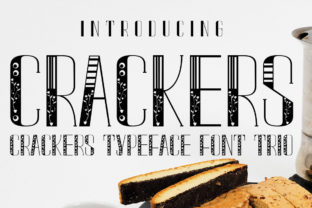
Crackers: A Whimsical Display Font That Delivers Personality—Without the Pitfalls
Crackers isn’t just another playful font—it’s a carefully crafted display typeface that balances charm and clarity. With its hand-drawn flair, subtle bounce in letterforms, and delicate floral embellishments (think tiny blossoms tucked into terminals and looping swashes), Crackers invites warmth and personality into headlines, invitations, packaging, and social graphics. It’s especially beloved by creators who want their work to feel human—not algorithmic—and by small business owners building brands with heart.
Why People Reach for Crackers (and Why Some Regret It Later)
Many designers choose Crackers because it *feels* right: joyful, approachable, memorable. That instinct is sound—but only when matched with intention. The problem isn’t the font itself; it’s how it’s used. Crackers shines brightest where legibility isn’t compromised by scale, context, or contrast. Yet too often, it ends up crammed into tiny app buttons, stretched across low-res banners, or layered over busy photos—undermining both its charm and your message.
Mistake #1: Using Crackers for Body Text or Small UI Elements
Crackers was designed as a display font—not for paragraphs, captions, or navigation menus. Its floral details and variable stroke widths soften at smaller sizes, turning readable words into blurry suggestions. One freelance educator told us she used Crackers for course module titles *and* bullet points in a digital workbook. Students reported skipping sections because “the text looked like scribbles.”
Better approach: Reserve Crackers for headings, logos, and short hero lines (5–12 words max). Pair it with a clean, highly legible sans-serif—like Inter, Lato, or even Roboto—for all supporting text. This contrast doesn’t dilute Crackers’ personality; it lets it breathe.
Mistake #2: Assuming All “Playful” Fonts Are Interchangeable
Not every whimsical font works the same way. Crackers has distinct rhythm and spacing built into its design. If you swap it in mid-project for a similar-looking free alternative—say, one with tighter kerning or heavier flourishes—you’ll likely notice awkward gaps, overlapping letters, or uneven line heights. Worse, licensing may not permit commercial use, risking takedowns or legal friction later.
Before downloading or buying: Check the official specimen sheet—not just the preview image. Look for real-world examples showing uppercase/lowercase balance, punctuation handling (especially ampersands and quotation marks), and how numbers behave. Crackers includes thoughtful alternates and ligatures; make sure your design tool supports OpenType features if you plan to use them.
Mistake #3: Ignoring Color, Contrast, and Background Context
Those floral elements? They’re delicate—not decorative afterthoughts. When Crackers appears on a textured background, a gradient, or a photo with midtone complexity, petals and stems can vanish. One boutique owner printed Crackers-based gift tags on kraft paper using light beige ink—only to find the floral details disappeared entirely under natural lighting.
Solution: Test Crackers at full size against your actual background *before finalizing*. Use high-contrast pairings: deep navy on cream, charcoal on soft white, or crisp black on matte pastel. Avoid placing it over busy patterns or anything with competing organic shapes (e.g., leafy stock photos). If you need transparency or overlays, export as vector (SVG) or high-res PNG—not JPEG—to preserve fine detail.
What to Verify Before You Commit
Crackers is available through reputable foundries and marketplaces—but not all licenses are equal. Here’s what to check before adding it to your cart or project:
- Licensing scope: Does it cover web embedding (with @font-face), app use, merchandise, or video? Some versions allow unlimited personal use but restrict resale of designs containing the font.
- File formats included: Look for OTF (OpenType) and WOFF2 for web. Avoid single-format bundles unless you’re certain of your needs.
- Language support: Crackers includes extended Latin characters (accents, ñ, ç, ü), but doesn’t cover Cyrillic or Greek. If your audience uses those scripts, confirm compatibility—or plan fallbacks.
- Updates & support: Reputable sellers offer updates for bug fixes or expanded glyphs. Check release notes and whether you’ll be notified of changes.
How Crackers Fits Into Real Workflows
Freelancers and small teams often assume playful fonts slow down production. Not true—with planning. One wedding stationery designer uses Crackers exclusively for suite headers (“Save the Date,” “RSVP,” “Details”) while keeping body copy in a neutral serif. She saves time by creating paragraph styles in InDesign with pre-set font stacks—and exports consistent SVGs for email headers and social previews.
For bloggers and educators, Crackers works beautifully in featured quote graphics or course title cards—especially when exported as transparent PNGs with optimized dimensions (e.g., 1200×630px for social). Just remember: always embed the font in PDFs for print, and convert to outlines before sending files to third-party printers.
A Final Note on Intentionality
Crackers succeeds not because it’s cute—but because it’s considered. Its floral motifs aren’t random; they echo botanical illustration traditions, lending authenticity to wellness brands, artisanal food labels, and creative workshops. When used without attention to hierarchy, spacing, or environment, that thoughtfulness gets lost. But when paired with care—clear purpose, smart contrast, and respectful scale—it becomes more than decoration. It becomes voice.
If you’re evaluating Crackers alongside other display fonts, ask yourself: does it serve the message—or distract from it? Does it reflect who you are *and* who you’re speaking to? And most importantly: have you tested it where it will actually live—not just in a mockup, but on the device, in the space, under the light your audience will see it in?
That kind of grounded testing separates memorable typography from forgettable trends. And that’s where Crackers earns its place—not as a flourish, but as a thoughtful choice.