Rustyhead: A Smart Retro Display Font
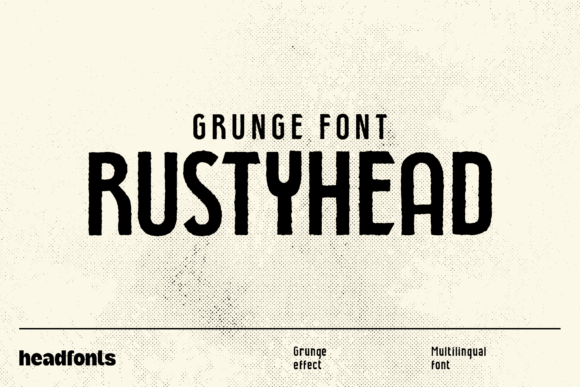
There’s something quietly magnetic about typefaces that feel both handmade and intentional—like they’ve been pulled from a sun-bleached sign shop or sketched on kraft paper with care. Rustyhead fits that feeling perfectly: a smart, retro display font with an original style rooted in rustic charm, not nostalgia for its own sake. It doesn’t imitate vintage—it reimagines it with precision, rhythm, and subtle intelligence.
What Makes Rustyhead Stand Out
Rustyhead isn’t just “rough” or “distressed.” Its letterforms balance irregularity with control: uneven stroke weights, slight asymmetry in curves, and thoughtful imperfections that suggest hand-crafted effort—not digital randomness. Each glyph feels considered, not chaotic. The spacing is tuned for readability at larger sizes, and the character set includes stylistic alternates and ligatures that let you fine-tune tone without switching fonts.
It’s designed as a display font—meant for headlines, logos, posters, packaging, and short impactful text—not body copy. That focus gives it expressive power where it matters most: first impressions.
For Designers & Creative Professionals
If you’re crafting brand identities or editorial layouts, Rustyhead offers a shortcut to authenticity. Its warmth helps humanize tech startups, craft breweries, or indie bookshops—without leaning into cliché. You’ll appreciate how its optical sizing works across print and screen, and how its OpenType features let you adjust personality on the fly (e.g., swapping a bolder “A” for a more delicate alternate in a logo lockup). Quality and flexibility matter here—and Rustyhead delivers both without overcomplicating your workflow.
For Small Business Owners & Marketers
You don’t need a design degree to recognize when a font makes your café menu feel inviting—or your product label feel trustworthy. Rustyhead’s rustic charm signals approachability and care, which resonates with customers who value local, handmade, or sustainable values. Unlike overly ornate scripts or generic sans-serifs, it stands out on social thumbnails and storefront signage while remaining legible and professional. For you, reliability and presentation are top priorities—and Rustyhead performs consistently across platforms, from Canva templates to Shopify banners.
For Educators & Content Creators
When you’re designing workshop handouts, course slides, or YouTube thumbnails, clarity and character both count. Rustyhead adds visual interest without sacrificing scannability—especially for titles and section headers. Its distinct letterforms help learners anchor key ideas visually. And because it avoids cartoonish or dated tropes, it feels fresh whether you’re teaching woodworking basics or digital literacy to adults. Here, learning value and long-term usefulness matter: a font that supports comprehension *and* reflects thoughtful curation.
For Beginners & Hobbyists
If you’re just starting with Canva, Figma, or even PowerPoint, Rustyhead is refreshingly straightforward. No steep learning curve—just install, type, and feel the difference a strong headline makes. Its built-in contrast does much of the work for you: no need to layer textures or fake distress effects. You’ll notice faster results, less second-guessing, and more confidence in your visual choices. For beginners, ease of use and immediate impact are essential—and Rustyhead delivers without demanding expertise.
For Freelancers & Publishers
When clients ask for “something warm but not twee,” “vintage but not kitschy,” or “bold but not aggressive,” Rustyhead often fits the brief before you even sketch alternatives. Its versatility across industries—from artisanal skincare to indie publishing—means you can reuse it thoughtfully across projects without repetition feeling obvious. Commercial value comes from recognition (clients remember work that feels distinctive) and efficiency (less time sourcing or customizing). And because it’s well-hinted and web-optimized, it renders cleanly in emails, EPUBs, and PDFs alike.
Practical Use Cases—Real and Specific
- A bakery owner uses Rustyhead for their chalkboard-style Instagram Stories—pairing it with a clean sans-serif for prices—to reinforce their “slow food, real ingredients” message.
- A freelance illustrator layers Rustyhead behind hand-drawn typography in a limited-edition poster series, using its alternates to echo brushstroke variation.
- A university extension program selects Rustyhead for workshop flyers—its friendly authority helps attract adult learners who might otherwise overlook continuing education offerings.
- A podcast host applies it sparingly to episode title cards: large, centered, with generous spacing—so it pops on mobile feeds without overwhelming audio-focused listeners.
What to Consider Before You Choose
Rustyhead shines brightest when used intentionally—not everywhere. It’s not meant for paragraphs, captions, or data tables. If your project demands heavy text usage, pairing it with a neutral, highly legible companion font (like a well-designed grotesk or humanist sans) is wise.
Cost and licensing are straightforward: it’s available as a one-time purchase with broad commercial rights—including use in client work, merchandise, and apps. No subscriptions, no hidden fees. For solopreneurs and small teams, that predictability matters more than flashy bundles.
Speed? Installation is quick. Rendering is fast—even on older devices. And because it’s a single-weight family (with stylistic options), file size stays light. No performance trade-offs for personality.
Does Rustyhead Fit Your Next Project?
Ask yourself:
- Is this for a headline, logo, poster, or other short-form visual context?
- Do you want warmth and character—without looking outdated or overly casual?
- Are you balancing creativity with clarity, not choosing between them?
- Do you value a font that works well whether you’re designing solo or collaborating across tools?
If three or more answers are “yes,” Rustyhead is likely a strong match. It won’t solve every typographic challenge—but for the right moment, it adds sincerity, distinction, and quiet confidence.
Its rustic charm isn’t about pretending to be old. It’s about honoring craft, intention, and the human hand behind design—even in digital spaces. And in a world full of algorithmically smoothed, endlessly scalable fonts, that kind of grounded originality is rare. And useful.