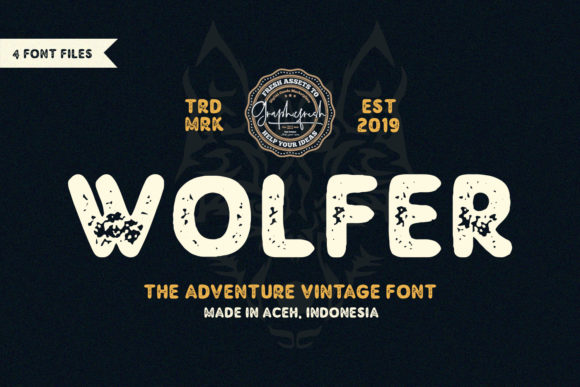
Wolfer: A Bold, Vintage-Inspired Display Font That Commands Attention
When your design needs to stop scrolling, spark curiosity, and leave a lasting impression—Wolfer delivers. More than just another display font, Wolfer is a carefully crafted typographic statement: strong, confident, and rich with vintage character. Its thick, assertive strokes, subtle serif flourishes, and balanced irregularity evoke mid-century signage and hand-painted advertisements—yet it feels unmistakably modern in application. If you're designing for impact—not just aesthetics—Wolfer is built to help you achieve it.
Many designers face the same recurring challenge: how to make key messages stand out without sacrificing authenticity or visual cohesion. Headers get lost in cluttered layouts. Branding feels generic. Marketing assets blend into the noise. And when time or budget limits custom illustration or bespoke lettering, a powerful typeface becomes your most accessible strategic tool. That’s where Wolfer steps in—not as decoration, but as functional emphasis with personality.
Why Wolfer Fits Real Design Needs
Wolfer isn’t meant for body text or long paragraphs. It’s purpose-built for moments that demand focus: logos, headlines, posters, packaging, social media banners, and hero sections. Its strength lies in intentionality—every curve, weight shift, and terminal has been tuned to project authority while retaining warmth. Unlike overly rigid geometric fonts or overly ornate scripts, Wolfer strikes a rare balance: bold enough to dominate at scale, yet human enough to feel approachable.
Consider these common scenarios—and how Wolfer helps:
- Small business branding: A local coffee roaster wants to signal craft, heritage, and confidence—not trendiness. Wolfer’s vintage sensibility reinforces authenticity without leaning into cliché (no faux-rust textures or forced distressing required).
- Digital campaign headers: On mobile-first platforms, readability at small sizes matters less than instant recognition at large ones. Wolfer’s high x-height and open counters ensure legibility even when scaled dramatically—critical for Instagram carousels or email subject lines that double as visual hooks.
- Event identity systems: Music festivals, art fairs, or retro-themed pop-ups benefit from typography that sets tone before a single image loads. Wolfer conveys energy and timelessness simultaneously—making it ideal for posters, tickets, and stage backdrops.
Practical Applications That Deliver Results
Getting great results with Wolfer starts with thoughtful pairing and restraint. Because it carries so much presence, it thrives when contrasted with clean, neutral supporting fonts—think sans-serifs like Inter, Poppins, or Lato for body copy and captions. This creates visual hierarchy without competition: Wolfer leads; the rest supports.
Here are three proven approaches, depending on your goals:
- Minimalist impact: Use Wolfer alone—no color shifts, no effects—on a stark white or deep charcoal background. This works exceptionally well for luxury goods, editorial mastheads, or premium service brands seeking quiet confidence over loudness.
- Vintage layering: Combine Wolfer with subtle texture overlays (e.g., a faint paper grain or soft halftone) and muted earth tones—ochre, slate blue, warm black. Ideal for artisanal food labels, boutique retail, or cultural institutions wanting tactile depth.
- Modern contrast: Set Wolfer in crisp white against vibrant gradients or bold photography. The juxtaposition of classic form and contemporary context creates dynamic tension—perfect for tech-adjacent creative studios or forward-thinking education programs.
Spacing matters too. Wolfer benefits from generous letter-spacing (tracking) at larger sizes—especially above 48px—to let its structure breathe. Avoid tight kerning unless intentionally evoking compact signage (e.g., diner menus or vintage storefronts). And always test across devices: its power holds up beautifully on retina displays, but ensure fallbacks are defined for environments where variable fonts aren’t supported.
Who Uses Wolfer—and How Their Approach Differs
Graphic designers often reach for Wolfer first when developing brand identities—they value its ability to anchor a visual system while leaving room for flexibility elsewhere. For them, Wolfer is a foundational choice, not a decorative afterthought.
Web developers and UI designers appreciate that Wolfer is available in robust web font formats—including WOFF2—with excellent load performance. When implemented via @font-face or a trusted CDN, it renders consistently across browsers and respects user preferences like reduced motion and forced colors—key for accessibility-conscious projects.
Content creators and marketers use Wolfer more selectively—but strategically. They might apply it only to email subject lines, YouTube thumbnails, or LinkedIn banner text: high-visibility touchpoints where milliseconds of attention translate directly into engagement. Their success hinges less on technical typography knowledge and more on understanding where emphasis yields measurable returns.
Things to Keep in Mind Before You Implement
While Wolfer excels in standout roles, it’s not universally appropriate. Avoid using it for:
- Long-form body text or interface labels (its expressive nature reduces scannability over time);
- Low-resolution print outputs (fine details may soften or fill in unintentionally);
- Brands aiming for ultra-minimalist, clinical, or strictly futuristic positioning (its warmth and texture may clash with those goals).
Licensing is straightforward—Wolfer is typically offered under desktop, web, and app licenses, with clear usage terms. Always verify permissions for commercial redistribution (e.g., if embedding in client-facing templates or SaaS dashboards). And remember: great typography supports strategy, not replaces it. Wolfer won’t fix unclear messaging—but it will make clear messaging unforgettable.
Ultimately, Wolfer serves a simple but vital purpose: helping ideas land with authority and charm. Whether you’re launching a new product, refreshing a legacy brand, or crafting a one-off campaign, its vintage-inspired strength gives your work distinction without effort. It doesn’t shout—it resonates. And in today’s saturated visual landscape, resonance is rarer—and more valuable—than volume.
If you’ve been searching for a display font that bridges heritage and relevance, confidence and approachability, impact and integrity—Wolfer isn’t just an option. It’s a solution, ready to elevate what matters most in your design.