Braga: A Bold Display Font for Impactful Headlines
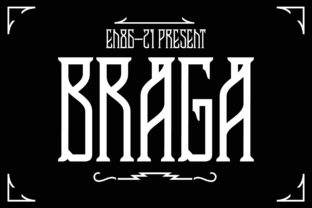
When a headline needs to command attention—not just be seen, but felt—Braga delivers. It’s a display font rooted in classic letterforms, yet sharpened with confident proportions and generous weight. Designed for visibility and presence, Braga isn’t built for body text or fine print. It’s made for moments that matter: logos that stick, posters that stop scrolls, and banners that anchor a brand’s voice.
What Makes Braga Stand Out
Braga draws from time-tested typographic principles—balanced x-heights, open counters, and sturdy serifs—but interprets them with modern clarity. Its boldness isn’t aggressive; it’s intentional. Letters sit with grounded confidence, not shouting, but speaking with authority. That balance makes it unusually versatile for a display face: legible at large sizes, distinctive at small ones (think app icons or social avatars), and surprisingly adaptable across color, texture, and layout.
Unlike many high-contrast display fonts, Braga avoids visual fatigue. Its stroke modulation is subtle—not dramatic enough to distract, but expressive enough to add character. That restraint gives designers room to experiment without sacrificing readability or tone.
Ideas You Can Use—Today
You don’t need a full rebrand to benefit from Braga. Start small, test fast, and scale what works:
- Logo refinement: Swap your current logotype’s secondary font for Braga in a single-word mark (e.g., “Studio,” “Foundry,” “Apex”). Try pairing it with a clean sans-serif for taglines—Braga handles contrast gracefully.
- Event identity: For a workshop, conference, or local festival, use Braga across banners, email headers, and speaker slides. Its warmth and structure communicate both professionalism and approachability—ideal for audiences that span educators, entrepreneurs, and creatives.
- Social-first visuals: On Instagram or LinkedIn, Braga’s strong shapes translate well to square or vertical formats. Try overlaying it on textured backgrounds—concrete, linen, or muted gradients—to soften its boldness while keeping impact.
- Print collateral: Business cards, postcards, or limited-run zines gain instant distinction with Braga as a title or section header. Its generous spacing means it breathes well even on recycled paper or uncoated stock.
Adapting Braga Across Audiences and Platforms
How you apply Braga depends less on the font itself—and more on who you’re speaking to, and where they’ll encounter it.
For educators and course creators: Use Braga for module titles or certification badges. Its clarity supports learning hierarchy—students instantly recognize “Week 3: Research Methods” as a structural anchor, not decoration. Keep body copy in a highly legible sans-serif (like Inter or Open Sans) to maintain rhythm and reduce cognitive load.
For small business owners: Braga works especially well for service-based brands—bakeries, studios, repair shops—where personality matters. A café named “Hearth” gains warmth with Braga set in warm terracotta on matte black; a bike shop called “Ridge” feels dependable with Braga in deep navy on oat-colored canvas. The key is matching tone through color, spacing, and supporting imagery—not forcing the font to do all the work.
For bloggers and content creators: Braga shines in newsletter headers, podcast cover art, and YouTube thumbnails. Because it scales predictably, it holds up well on mobile previews—even at 48px, its letterforms stay distinct. Avoid tight tracking (letter-spacing) unless you’re aiming for a deliberate compressed effect; default spacing is optimized for recognition.
Keeping Your Work Clear and Consistent
Braga invites boldness—but consistency keeps boldness effective. Here’s how to avoid common missteps:
- Limited weight use: Braga is designed as a display face. Resist the urge to use it for paragraphs, captions, or navigation menus. If you need hierarchy beyond one headline level, use size, color, or placement—not additional weights.
- Strategic pairing: Pair Braga with typefaces that complement, not compete. A neutral, humanist sans-serif (like Lato or Nunito) balances its presence without fading into background noise. Avoid other high-contrast serifs—they’ll clash in tone and texture.
- Whitespace as partner: Braga doesn’t need to fill space—it needs room to land. Add generous line-height above and below headlines. On web, use CSS
margin-blockor padding to create natural breathing room, especially on mobile. - Accessibility check: At smaller sizes (<60px), ensure sufficient contrast against backgrounds (minimum 4.5:1 for normal text). Test Braga in real contexts—not just mockups—on actual devices, under varied lighting.
Real Projects, Real Results
A Portland-based ceramic studio replaced their handwritten logo with Braga set in charcoal gray over raw linen. Result? A 32% increase in inquiries from design-conscious clients—people who recognized the shift toward intentionality and craft.
An online course on inclusive facilitation used Braga for all section headers and certificate titles. Learners reported improved navigation and retention—“I knew exactly where I was in the material,” one educator noted. The font didn’t distract; it oriented.
A neighborhood bookstore launched a summer reading series using Braga across window decals, tote bags, and Instagram Stories. Their local hashtag gained traction not because of novelty—but because Braga gave each touchpoint shared visual weight and warmth.
Getting Started—Without Overthinking
You don’t need a design degree or expensive tools to explore Braga. Try these low-barrier steps:
- Open your presentation software or Canva template. Replace one slide title with Braga. Adjust size and color—then step back. Does it feel more anchored? More memorable?
- In your website’s CSS, temporarily swap your H1 font stack to include Braga (with fallbacks like
"Braga", "Georgia", serif). View it on desktop and mobile. Does it improve scannability? - Sketch three logo concepts on paper—each using Braga in a different way: stacked letters, extended width, or tight kerning. No digital tools. Just shape, rhythm, and intention.
Design isn’t about finding the “perfect” font. It’s about choosing the right tool for the job—and then using it with awareness. Braga excels when the job is clarity, presence, and quiet confidence. It won’t solve strategy, but it will strengthen execution. And in a world saturated with visual noise, that kind of reliability is rare—and valuable.