Leonid: Bold, Handwritten, Retro-Ready
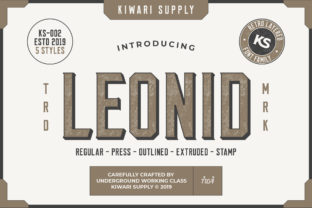
If you’ve ever stared at a blank design canvas wondering how to inject instant character—without overcomplicating things—you’re not alone. Leonid isn’t just another handwritten font. It’s a confident, slightly irreverent, boldly inked presence that lands like a vintage concert poster taped to a brick wall: unmistakable, full of energy, and quietly intentional. Designed with thick, rhythmic strokes and subtle irregularities, Leonid leans into its handmade roots without sacrificing clarity or impact.
A Font That Feels Like a Decision, Not an Afterthought
Leonid is a premium display font—meaning it shines brightest where attention matters most: headlines, logos, packaging, social banners, book covers, and event posters. Its weight and rhythm give it natural hierarchy; it doesn’t beg for emphasis—it commands it. Unlike delicate script fonts that blur at small sizes or overly tight sans serifs that flatten personality, Leonid balances boldness with legibility. Letters have generous spacing, open counters, and consistent stroke contrast—so even at 36pt on a café menu or 72pt on an Instagram story, it reads cleanly and feels human.
You’ll notice the slight tilt in its baseline, the occasional lifted terminal, the confident downstrokes—details that whisper “hand-drawn” but never shout “unprofessional.” That’s intentional. Leonid avoids the trap of looking like a rushed doodle. Instead, it carries the warmth of authenticity with the polish of considered design.
Where Leonid Fits—and Where It Doesn’t
Think of Leonid as your go-to for moments when tone matters more than neutrality. It’s ideal for:
- Craft brands launching small-batch goods—think ceramic studios, indie roasters, or handmade soap labels—where warmth and individuality reinforce trust;
- Retro-themed campaigns, whether it’s a vinyl reissue announcement, a ’70s-inspired fashion drop, or a local music festival poster;
- Editorial design in magazines or zines leaning into analog aesthetics—especially mastheads, section headers, or pull quotes;
- Social media graphics that need to stop the scroll: limited-time offers, workshop announcements, or behind-the-scenes stories;
- Brand identity systems built around approachability and craft—paired thoughtfully, Leonid can anchor a logo while supporting typefaces handle body text.
It’s less suited for dense paragraphs, legal disclaimers, data dashboards, or interfaces requiring rapid scanning. Leonid is a voice—not background noise. Use it where you want people to pause, recognize, and remember.
Pairing Leonid Without Overthinking It
Great pairings aren’t about opposites attracting—they’re about contrast with cohesion. Leonid works beautifully with typefaces that ground its energy. Try it alongside:
- A warm, neutral sans serif (like Poppins, Inter, or DM Sans) for clean, modern balance—ideal for websites or product packaging where Leonid handles headlines and the sans carries descriptions;
- A relaxed serif (such as Lora or Merriweather) for editorial or publishing projects—adding texture without competing;
- A minimalist monospace (like IBM Plex Mono or JetBrains Mono) for creative tech brands or maker-focused content—creating an unexpected but grounded dialogue between analog and digital.
Avoid pairing Leonid with other high-contrast scripts or overly decorative fonts. You’ll dilute its strength. And skip ultra-thin or tightly spaced sans serifs—they’ll visually recede too much, making Leonid feel isolated instead of anchored.
What’s Actually Included—and Why It Matters
Most versions of Leonid include uppercase and lowercase letters, numerals, punctuation, and basic multilingual support (including Latin-1 and Latin Extended-A). Some releases offer stylistic alternates—like swash capitals or alternate ‘g’ or ‘y’ forms—that add nuance without requiring design gymnastics. Check the specimen sheet before downloading: if your project needs OpenType features (ligatures, case-sensitive forms), verify they’re present.
Readability at smaller sizes? Test early. While Leonid holds up well at 24–30pt in print or high-res digital use, avoid using it below 18pt in body copy—even with generous line height. Its charm lives in scale and intention, not subtlety.
Licensing That Supports Real Work
Leonid is typically offered as a commercial font, meaning it’s licensed for business use—but always confirm the license terms before deploying it in client work, merchandise, or apps. Personal use licenses won’t cover logo design for a bakery, web banners for an e-commerce site, or printed menus for a pop-up restaurant. Reputable sellers provide clear, plain-language licensing details. If the page only says “for personal use,” assume it’s not safe for client or commercial projects—no exceptions.
Also note: web use requires a separate web font license (often delivered as WOFF2 files), not just a desktop install. Embedding Leonid via @font-face without the proper license risks takedowns or legal exposure—especially for brands with active marketing teams or agencies managing multiple clients.
A Final Note on Trust and Tone
Typography isn’t decoration—it’s part of how people decide whether to listen to you. Leonid signals confidence without arrogance, creativity without chaos, nostalgia without imitation. When used deliberately—on a band’s album cover, a boutique’s storefront sign, or a newsletter header—it tells your audience: This was made by someone who cares about how things feel, not just how they look.
That resonance doesn’t come from trend-chasing. It comes from choosing tools aligned with your message—and Leonid, with its bold hand, quiet consistency, and retro-ready soul, earns its place in real-world design work. Not because it’s “cool,” but because it works—clearly, reliably, and memorably.