The Senom: Handwritten Power, Textured & Bold
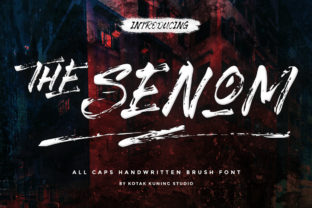
Imagine opening a design file and instantly feeling the weight of intention—brush strokes that breathe, ink that pools just right, textures that catch light like real paper. That’s The Senom: an all-caps handwritten brush font built not just to look hand-drawn, but to *feel* authentically tactile. Every glyph carries subtle grain, pressure variation, and organic irregularity—no two letters are perfectly identical, yet they harmonize with striking consistency.
Why “textured” isn’t just decoration—it’s meaning
Texture in a font does more than add visual interest. It signals authenticity, human effort, and emotional resonance. Where a sleek sans-serif says “efficient,” The Senom says “crafted.” It doesn’t simulate handwriting—it evokes the gesture behind it: the wrist lift, the drag of bristles, the slight tremor of confidence. That’s why its texture isn’t applied as an overlay; it’s baked into the vector outlines and carefully balanced across weights and characters.
For designers & branding professionals
You’re evaluating fonts for a client’s rebrand—maybe a ceramic studio, a boutique coffee roaster, or a wellness retreat. Clean typography has its place, but when warmth, approachability, and artisanal credibility matter most, The Senom delivers immediate tonal clarity. Its uppercase-only structure lends boldness to signage and packaging, while its natural imperfections prevent sterility. You’ll test it at large sizes first—logos, hero banners, letterpress-style business cards—where texture reads as richness, not noise.
For educators & workshop leaders
You create printable resources for students or participants: quote posters, reflection prompts, classroom rules, or welcome banners. The Senom helps signal “this is thoughtful, intentional, human-made”—not auto-generated. Its strong legibility (despite being brush-based) means it works well even at 24–36pt on handouts or slides. Teachers using Canva or Google Slides appreciate how quickly it elevates a simple layout without requiring advanced design skills. Bonus: students often respond more warmly to materials that feel personally crafted—not templated.
For small business owners & solopreneurs
You’re building your own brand assets—social media posts, email headers, product labels—with limited time and no designer on retainer. The Senom gives you high-impact visual distinction fast. A bakery owner might use it for “SOURDOUGH” on a chalkboard-style Instagram story; a yoga instructor for “BREATHE” on a class handout. Because it’s all-caps and highly legible, it avoids the readability pitfalls some script fonts introduce. You don’t need to kern every word—its spacing was fine-tuned for real-world use, not just specimen displays.
For hobbyists & personal project makers
You’re designing a wedding invitation, a memory journal cover, or a framed lyric print for your living room. Here, The Senom shines as a tool for emotional expression—not just aesthetics. Its texture invites touch, even visually. You might layer it over a scanned watercolor background or pair it with minimalist sans-serifs for contrast. Since it’s a single-weight, single-style font (not a family), it encourages focus: one strong voice, not endless options. That simplicity reduces decision fatigue—a quiet win for anyone creating just for joy.
What changes depending on your goals—and what stays true
Beginners often prioritize ease of use and instant impact. With The Senom, that means dragging it into Canva or Illustrator and seeing results immediately—no tutorials needed. There’s no ligature chaos to untangle, no alternate glyphs to manage. What you type is what you get: bold, textured, unmistakably hand-brushed.
Experienced users care more about flexibility within constraint. Yes, it’s uppercase only—but that limitation becomes a strength in editorial layouts, exhibition titles, or apparel prints where hierarchy matters. Designers who’ve wrestled with overly ornate scripts appreciate its restraint: expressive, yes—but never distracting from the message.
Commercial users weigh licensing clarity and long-term usability. The Senom typically includes standard desktop and web licenses, covering most small-to-midsize business needs—including merchandising and digital ads. No hidden tiers for social media or e-commerce use. If your goal is consistent, recognizable branding across platforms (website headers, Instagram highlights, printed tags), its reliability matters more than having ten stylistic alternates.
When The Senom fits—and when it might not
It fits best when your project benefits from authority + warmth: a keynote slide title, a book cover subtitle, a craft fair banner, a teacher’s classroom motto, or a podcast episode graphic needing gravitas without stiffness.
It’s less ideal if you need lowercase letters for body text, require extensive language support beyond basic Latin, or are designing interfaces where scannability trumps atmosphere (like app navigation or data dashboards). It’s also not meant to replace a full type system—think of it as your standout voice, not your entire vocabulary.
- Need speed? Use it for headlines, logos, and short phrases—no time lost tweaking baselines or tracking.
- Value learning value? Study how its stroke contrast and exit angles create rhythm—great for typography beginners observing real-world letterform logic.
- Prioritize commercial safety? Check the license terms before applying it to client work—but most versions allow exactly that, with clear attribution guidelines.
- Seeking creative spark? Try pairing it with a crisp geometric sans (like Montserrat or Inter) or a soft serif (like Cormorant Garamond)—the contrast makes both fonts sing.
Ultimately, The Senom isn’t about chasing trends. It’s about choosing a voice that carries presence without shouting—texture that grounds rather than overwhelms. Whether you’re launching a side hustle, preparing a lesson plan, framing a poem, or refining a brand’s visual tone, it offers something increasingly rare: handmade character, engineered for real use.
If your work thrives on sincerity, strength, and a little beautiful imperfection—The Senom isn’t just another font. It’s a deliberate choice to let humanity show through.