Rockleys: A Display Font with Strategic Edge
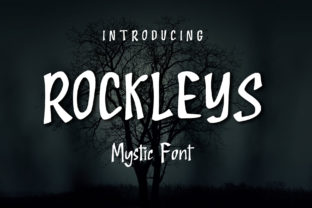
Rockleys isn’t just another decorative typeface—it’s a deliberate visual signal. With its hand-drawn irregularity, uneven stroke contrast, and unpolished rhythm, Rockleys carries a distinct personality: confident but unpretentious, contemporary but grounded, energetic without being chaotic. It doesn’t whisper—it leans in. That makes it unusually potent when used with intention—not as decoration, but as a strategic tool for emphasis, differentiation, and emotional resonance.
Why Rockleys Works Where Other Display Fonts Don’t
Most display fonts fall into one of two traps: they’re either overly slick (losing authenticity) or too eccentric (sacrificing legibility and trust). Rockleys avoids both by balancing rawness with structure. Its baseline wobbles slightly, letters occasionally overlap or shift vertically—but spacing remains consistent enough to support quick scanning. That tension—between control and spontaneity—is precisely what gives Rockleys its contemporary charm and functional utility.
This isn’t about aesthetics alone. It’s about alignment. When your message hinges on immediacy, human connection, or creative authority—like a workshop title, a campaign headline, or a product launch banner—Rockleys signals that you’re not defaulting to safe, corporate neutrality. You’re choosing presence over polish. And that choice communicates something real to audiences who’ve grown skeptical of overproduced visuals.
Where Rockleys Delivers Real Strategic Value
Use Rockleys where attention is scarce and meaning must land fast:
- Event branding: Conference banners, speaker slides, or workshop posters benefit from Rockleys’ energy—especially when targeting creators, educators, or independent professionals who value authenticity over formality.
- Digital campaign headers: On landing pages or email subject lines, Rockleys draws the eye without requiring animation or color tricks. Its texture adds weight to short, action-oriented copy like “Start Your Studio” or “Build With Intention.”
- Printed collateral with tactile intent: Business cards, zines, or limited-run packaging gain dimension when Rockleys appears alongside a restrained sans-serif body font—creating hierarchy through contrast, not size alone.
- Educational or editorial highlights: In newsletters or course modules, Rockleys can mark key takeaways, reflection prompts, or section dividers—helping learners visually anchor concepts without disrupting flow.
What ties these use cases together isn’t style—it’s strategic placement. Rockleys earns its place only when it supports a clear communication goal, not when it fills empty space.
When Rockleys Should Stay in the Toolkit—Not on the Page
Rockleys is not a workhorse. It’s not meant for body text, data tables, legal disclaimers, or interface labels. Its expressive qualities become liabilities where clarity, speed, or accessibility are primary concerns. Using Rockleys for navigation menus, pricing plans, or step-by-step instructions introduces friction—not flair.
More subtly, Rockleys can undermine credibility if misaligned with audience expectations. A financial advisor using Rockleys in a client report may unintentionally signal informality at odds with fiduciary responsibility. Similarly, an academic journal applying Rockleys to article titles risks diluting scholarly tone—unless the publication deliberately foregrounds interdisciplinary creativity or critical design thinking.
The risk isn’t in the font itself—it’s in skipping the question: What outcome do we want this text to produce? If the answer is “readability at scale,” “trust through consistency,” or “neutral authority,” Rockleys is likely the wrong choice. If the answer is “memorable impact,” “creative positioning,” or “human-centered emphasis,” it becomes a strong candidate.
How to Use Rockleys with Discipline—Not Decoration
Start with constraints—not inspiration. Before typing a single word in Rockleys, define:
- The specific action you want the reader to take (e.g., register, reflect, share, pause).
- The minimum viable legibility required (e.g., 32px minimum on web; avoid all-caps below 48px).
- The typographic pairings that will absorb its energy—typically a neutral, highly legible sans-serif like Inter, Manrope, or IBM Plex Sans for supporting text.
Then test—not just visually, but behaviorally. Does a headline in Rockleys increase click-through on a campaign page? Does it improve recall in a workshop handout? Does it strengthen brand recognition across touchpoints over time? These aren’t design questions. They’re decision-making questions—and Rockleys should earn its place through measurable contribution, not assumed appeal.
Pairing Rockleys Without Compromise
Its strength lies in contrast—not isolation. Rockleys thrives when anchored by typography that provides stability. Think of it as the lead vocalist supported by a tight rhythm section: expressive, but never unmoored.
Avoid pairing Rockleys with other high-contrast or decorative fonts. No script fonts, no distressed serifs, no ultra-thin moderns. Instead, choose body fonts with generous x-heights, open counters, and even color distribution—qualities that let Rockleys shine without competing. The result isn’t “pretty”—it’s purposeful. One voice leads; the others enable.
This principle extends beyond type. Rockleys works best against clean backgrounds, ample whitespace, and restrained color palettes. Let its texture breathe. Overloading it with gradients, shadows, or busy imagery diminishes its impact—and your control over the message.
Long-Term Positioning: Beyond the First Impression
Consider how Rockleys functions in your broader visual language—not just today, but six months or two years from now. Will it still feel authentic as your brand evolves? Does it scale across formats—from mobile app splash screens to trade show signage—without losing legibility or intent?
Brands that use Rockleys most effectively treat it as a signature accent—not a crutch. They deploy it consistently in high-impact, low-frequency moments: keynote slide titles, chapter openers in digital courses, limited-edition product names. That restraint preserves its power. Every repeated use reinforces association—not dilutes it.
That discipline pays off in long-term recognition. When audiences begin to associate Rockleys with your voice—your clarity, your creative confidence, your willingness to stand out without shouting—they’re not remembering a font. They’re remembering how you make them feel when information matters.
Final Guidance: Choose Rockleys Like a Decision-Maker, Not a Designer
You don’t need to love Rockleys. You need to understand what it does—and what it costs.
It costs extra attention in layout (tracking and kerning require manual adjustment). It costs testing time (especially for accessibility compliance at smaller sizes). It costs consistency effort (ensuring it’s never used where neutrality or precision is required).
But it also delivers something rare: the ability to convey warmth, wit, and conviction in a single line of text—without relying on imagery, tone-of-voice cues, or contextual explanation.
So ask yourself: Is this moment worth that kind of emphasis? Does this message benefit from human imperfection—or does it demand machine-like clarity? If Rockleys answers “yes” to the first and “no” to the second, then use it boldly. If not, set it aside. Your strategy—not your toolkit—should drive the choice.
Because in the end, Rockleys isn’t about looking cool. It’s about communicating with confidence, clarity, and care—even when the edges aren’t perfectly straight.