The Grim Reaper: A Halloween Font with Edge
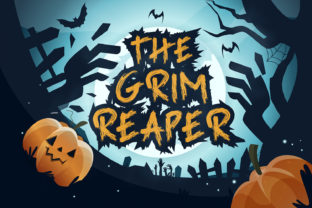
Imagine a font that doesn’t just say “spooky”—it cackles, winks, and leans in with a crooked grin. The Grim Reaper isn’t your typical gothic typeface. It’s got jagged serifs like cracked tombstone edges, uneven baseline alignment that feels hand-carved, and playful irregularities—like a witch’s spell gone charmingly sideways. It’s rough enough to unsettle, whimsical enough to invite. And yes, it works brilliantly beyond October 31st.
What makes The Grim Reaper more than just another Halloween font?
At its core, The Grim Reaper is a display font designed for impact—not body text. Its letterforms blend macabre motifs (think skeletal curves, hollowed-out counters, and asymmetrical terminals) with lighthearted quirks: a slightly tilted ‘R’, a looping ‘g’ that doubles as a ghost tail, or an ‘a’ that looks like it’s mid-cackle. It’s not digitally perfect—and that’s the point. That intentional imperfection signals authenticity, personality, and creative intention.
Unlike many seasonal fonts that vanish after Halloween, The Grim Reaper holds up in contexts where tone matters as much as legibility: indie book covers, boutique packaging, event posters, classroom decorations, or even playful brand refreshes. It’s versatile *because* it’s distinctive—not despite it.
Why does this font matter—to you?
Your relationship with The Grim Reaper depends less on what it is, and more on what you’re trying to do—and who you’re speaking to.
For creators and designers
If you craft visual identities, merch, or social content, The Grim Reaper offers quick tonal clarity. A bakery launching a “Witch’s Brew” cupcake line? Pairing The Grim Reaper with a soft rounded sans-serif creates delightful contrast—spooky but sweet. You’ll care about flexibility: Does it include ligatures? Alternate characters? Multilingual support? (It includes standard Latin-1 and basic OpenType features—but no Cyrillic or Vietnamese glyphs.) You’ll also weigh presentation value: how well it scales across print, web, and embroidery files.
For educators and librarians
A middle-school teacher designing a “Myth & Monster” unit might use The Grim Reaper for title slides or reading challenge banners—not to scare students, but to spark curiosity. Here, engagement and accessibility are priorities. It’s readable at large sizes, but avoid using it for paragraph text or low-vision learners’ handouts. Instead, pair it with a highly legible sans-serif for body copy. Bonus: students often respond enthusiastically to fonts with narrative energy—it turns typography into a conversation starter about mood, symbolism, and design choices.
For small business owners and marketers
Think seasonal pop-ups, local haunted trail signage, or a craft brewery’s limited-edition stout label. For these uses, The Grim Reaper delivers instant recognition and shareable charm. You’ll prioritize commercial licensing clarity—good news: it’s available under a standard desktop + web license, with clear terms for merchandise and social use. No hidden fees, no need to track impressions. What you won’t get is variable font support or extensive weight options (it’s a single bold-weight display face), so if your brand system relies on fine-grained typographic hierarchy, you’ll want to layer it thoughtfully—not lean on it alone.
For hobbyists and DIYers
Whether you're printing trick-or-treat bags, designing digital invitations, or carving pumpkins with stencils, The Grim Reaper adds character without complexity. Its straightforward installation (OTF/TTF) and compatibility with Canva, Cricut Design Space, and Adobe apps mean you won’t waste hours troubleshooting. You’ll appreciate that it doesn’t demand advanced skills—just an eye for contrast and timing. Try it over a muted charcoal background with gold foil accents, or reverse it out of black cardstock for a clean, eerie effect.
For writers and publishers
Indie authors releasing a cozy mystery or paranormal romance might use The Grim Reaper for chapter headings or series logos—not full manuscripts. It signals genre fast, helping readers self-select. Here, tone consistency matters more than technical range. If your cover already uses distressed textures or vintage halftones, The Grim Reaper integrates naturally. Just remember: it’s a supporting actor, not the lead. Let your serif or sans-serif body font carry the narrative weight.
What shouldn’t you expect from The Grim Reaper?
It’s not a workhorse font. You won’t set blog posts, legal disclaimers, or multilingual menus in it. It lacks true italics, small caps, or light/medium weights—so don’t reach for it when nuance or subtlety is required. And while its Halloween roots are undeniable, its usefulness isn’t confined to October. Used sparingly and intentionally, it brings warmth, wit, and welcome disruption to projects that benefit from expressive typography.
How to tell if The Grim Reaper fits your project
Ask yourself three things:
- Does the project need immediate emotional resonance? If yes—and that emotion is playful dread, nostalgic mischief, or affectionate spookiness—this font delivers.
- Is legibility at large sizes more important than micro-typographic control? The Grim Reaper shines on posters, mugs, and signage, not spreadsheets or footnotes.
- Do you have room to pair it well? Great results come from contrast: team it with a friendly geometric sans (like Poppins or Inter) or a warm serif (like Merriweather or Cormorant Garamond). Avoid pairing it with other decorative or overly ornate fonts—that’s where clutter begins.
One final note: The Grim Reaper isn’t about shock value. It’s about voice. Whether you’re a freelancer pitching a retro-chic rebrand, a parent planning a themed birthday party, or a curator designing an exhibition identity, this font gives you permission to be specific, memorable, and human—not generic or safe.
So before you default to “Halloween font free download,” pause. Consider whether you want something that merely signals the season—or something that helps your message land with character, clarity, and a little wink from the shadows.