Historical Duo: A Font Pair That Feels Human, Not Handcrafted
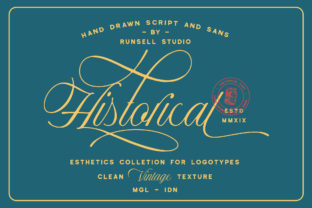
Historical Duo isn’t just another font bundle—it’s a thoughtful pairing built for moments when you need clarity *and* character in the same design. It brings together two distinct voices: a clean, subtly textured sans serif and a warm, expressive script with rich alternate characters and intelligent ligatures. Neither feels overly polished nor artificially distressed—instead, they carry quiet confidence, like handwriting that’s practiced but never stiff, or typography that breathes without shouting.
Where You’ll Reach for Historical Duo First
You don’t wait for “the perfect project” to use Historical Duo—you reach for it when something feels off in your current layout. Maybe the headline font is too clinical next to a hand-drawn logo. Or the quote graphic on your blog post reads like a corporate memo instead of a real person speaking. Or your small-batch candle label looks sharp online but loses warmth on physical packaging. That’s where Historical Duo steps in—not as decoration, but as quiet alignment between tone and type.
For Bloggers & Educators: Voice Without Vagueness
A science educator building a newsletter about climate literacy doesn’t want playful fonts that undermine credibility—but she also doesn’t want sterile tech fonts that make complex ideas feel cold. With Historical Duo, she sets body text in the sans (light weight, generous spacing) for readability, then uses the script for pull quotes or section headers. The script’s alternates let her avoid repetition—“Understanding” might show a swash ‘U’, while “Action” gets a connected ‘A’–‘c’ ligature—giving rhythm without gimmickry. Readers notice the care, not the font.
For Small Business Owners: Branding That Ages Well
A ceramicist launching her first online shop tested three font combos before landing on Historical Duo. Her product photos are soft-lit and tactile; her writing is warm but precise. The sans serif anchors her site navigation and pricing tables—no distractions, just calm legibility. The script appears only in her “About” banner and handwritten-style thank-you notes inside orders. Because the script includes true stylistic sets (not just random swashes), she can toggle between formal and friendly versions depending on context—no redesign needed later.
For Freelancers & Marketers: Presentations That Stick
You’ve spent hours refining a client pitch deck—and then opened it on a borrowed laptop to find all the script text collapsed into default system fonts. With Historical Duo, that risk drops because its OpenType features (like contextual alternates and discretionary ligatures) are built for real-world use, not just demo slides. When you export a PDF or embed fonts in Keynote, the connections hold. The script doesn’t look “designed”—it looks *written*, which makes data feel more grounded and recommendations feel more considered.
Why the Duo Works—Not Just Looks Nice
It’s easy to love a beautiful script—but hard to use one without undermining trust or accessibility. Historical Duo solves that by making the script *supportive*, not dominant. Its x-height matches the sans serif closely, so switching between them creates visual harmony, not whiplash. The sans has gentle texture—not grunge, not noise—just enough grain to soften digital harshness. And the script’s letterforms have consistent pressure variation, so it reads quickly at medium sizes (think 24–36pt), unlike many scripts that blur or collapse below 40pt.
This balance matters most in hybrid environments: a printed workshop workbook that also lives as a downloadable PDF, a Shopify store where mobile readability is non-negotiable, or an Instagram carousel where text must land in under two seconds. Historical Duo doesn’t ask you to choose between personality and practicality—it assumes you need both, every day.
Realistic Considerations Before You Use It
Historical Duo shines brightest when used with restraint—not as wallpaper, but as punctuation. If your brand voice is highly technical (e.g., cybersecurity tools or medical device documentation), lean heavier on the sans and use the script sparingly, like for signature lines or milestone announcements. If your audience skews older or reads on low-resolution screens, test the script at 28pt and above before finalizing layouts.
Also note: the script’s beauty comes from its OpenType intelligence. Basic editors like Canva or Google Slides won’t access its full range of alternates or ligatures—you’ll need software like Adobe Illustrator, Affinity Designer, or even modern versions of Figma with OpenType panel support. That’s not a limitation—it’s a signal that this duo rewards intentionality. You’re not grabbing a quick fix; you’re choosing how voice shows up.
Everyday Moments Where Historical Duo Fits Quietly
- A homeschool parent designing printable history worksheets: uses the sans for instructions and dates, the script for era names (“Victorian Era”, “Renaissance”)—making timelines feel anchored in time, not just typography.
- A podcast host creating audiogram thumbnails: pairs the sans for episode numbers and timestamps (clear, scannable) with the script for guest names—adding humanity without sacrificing speed.
- A nonprofit fundraiser drafting a year-end impact report: sets donor quotes in the script (with varied alternates so no two quotes look identical) while keeping stats, charts, and footnotes in the sans—honoring emotion and evidence equally.
- A wedding stationer typesetting invitations: uses the script for names and ceremony details (with elegant ‘&’ ligatures), then switches to the sans for RSVP deadlines and venue addresses—ensuring guests find logistics fast, even if they’re skimming on their phone.
What ties these uses together isn’t style—it’s respect. Respect for the reader’s time. Respect for the message’s weight. Respect for the fact that good typography shouldn’t need explanation. Historical Duo doesn’t shout “look how creative I am.” It says, “I listened—and made space for what matters.”
That’s why designers return to it for client work *and* personal projects, why educators use it in lesson plans and newsletters alike, and why small business owners keep it installed long after the launch phase ends. It’s not about chasing trends. It’s about finding a pair of voices that stay honest, readable, and quietly memorable—across devices, audiences, and years.